Mastering the Guitar Fretboard
Mastering the Guitar Fretboard: The Ultimate Guide to Learning Notes, Scales & Neck Navigation
Why Learning the Guitar Fretboard Changes Everything
Many beginner and intermediate guitar players struggle with the same problem: the fretboard feels confusing and impossible to memorize. The guitar neck can look like a random collection of dots, strings, and shapes with no clear system.
In reality, the guitar fretboard is built on logical, repeatable patterns. Once you understand how notes, intervals, octaves, and chord shapes connect, the neck becomes much easier to navigate.
How to Understand the Guitar Neck: Methods, Maps & Easy Techniques for Every Player
This complete guide will teach you:
- How to memorize the guitar fretboard fast
- How to find notes anywhere on the neck
- How the CAGED system works
- How pentatonic scale boxes connect
- The best exercises for fretboard mastery
- Common mistakes guitarists should avoid
Whether you play rock, blues, metal, jazz, or acoustic guitar, learning the fretboard is one of the most important skills you can develop.
Mastering the Guitar Fretboard
1. Guitar Fretboard Basics: Understanding the Musical Alphabet
The 12 Notes of Music
Before learning scales and chord shapes, you need to understand the musical alphabet that forms the foundation of the guitar fretboard.
Music contains:
- 7 natural notes: A, B, C, D, E, F, G
- 5 sharps/flats (accidentals)
The Golden Rule of Music Theory
There is:
- No sharp or flat between B and C
- No sharp or flat between E and F
The Full Chromatic Scale
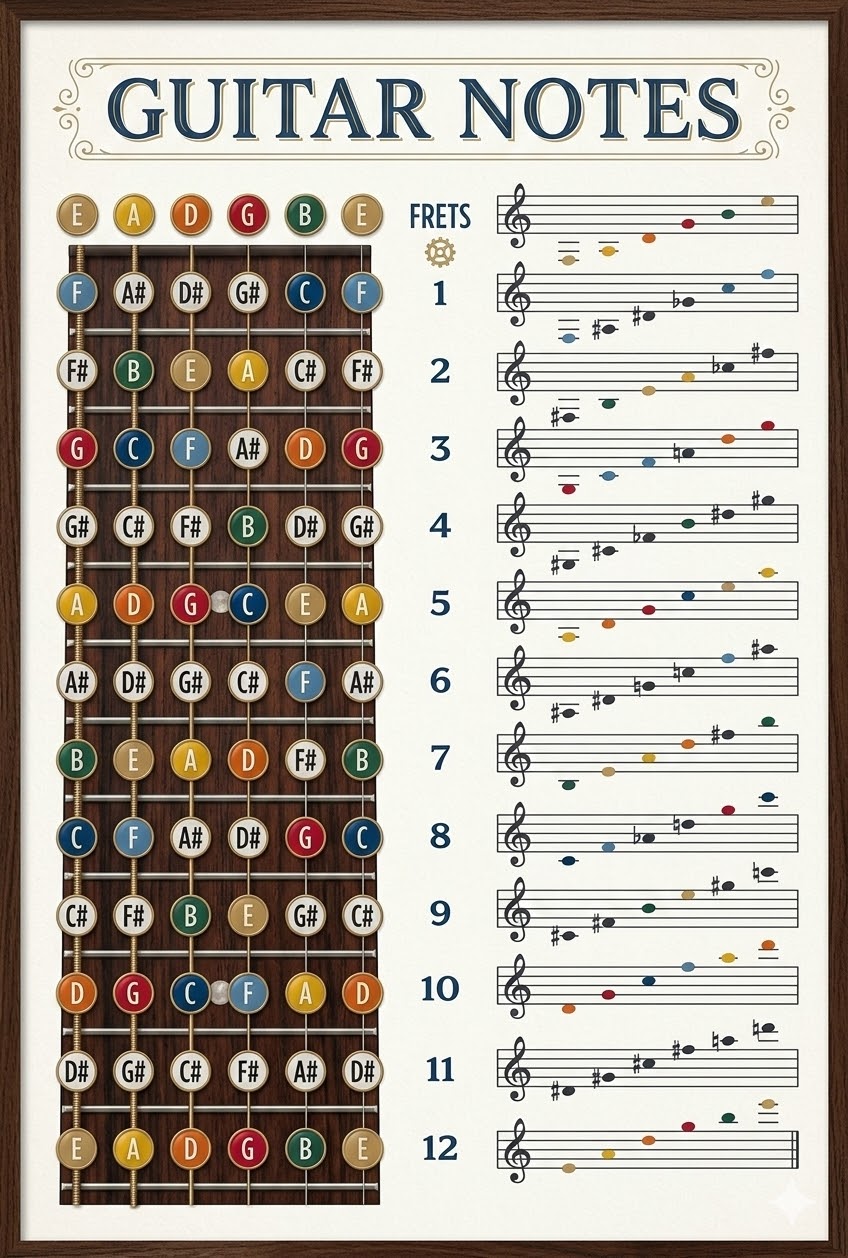
A – A#/Bb – B – C – C#/Db – D – D#/Eb – E – F – F#/Gb – G – G#/Ab – A
One Fret Equals One Half-Step
Every fret on the guitar moves the note up by one half-step.
For example:
- Open E string → F at the 1st fret
- F → F# at the 2nd fret
- F# → G at the 3rd fret
Understanding this pattern is the first step toward complete fretboard fluency.
The 12th Fret Rule
The 12th fret represents an octave, where the notes repeat.
This means:
- The 12th fret on the low E string is also E
- The entire fretboard pattern repeats after the 12th fret
If you learn the first 12 frets, you effectively know the entire guitar neck.
2. Memorizing the Open Guitar Strings
Standard Guitar Tuning Explained
The six open strings from thickest to thinnest are:
| String | Note |
|---|---|
| 6th String | E |
| 5th String | A |
| 4th String | D |
| 3rd String | G |
| 2nd String | B |
| 1st String | E |
Easy Mnemonic for Guitar Strings
Use this phrase to remember the string names:
Eddie Ate Dynamite, Good Bye Eddie
Memorizing the open strings creates your “home base” for locating notes all over the fretboard.
3. How to Learn Guitar Notes Fast Using Octave Shapes
The Octave Method for Guitar Fretboard Mastery
One of the fastest ways to learn the guitar neck is by using octave patterns.
Instead of memorizing every fret individually, you learn repeatable note shapes across the strings.
Standard Octave Shape
For notes starting on the:
- 6th string
- 5th string
Move:
- Up two strings
- Forward two frets
Example
A G note on:
- 3rd fret of the 6th string
Has its octave on:
- 5th fret of the 4th string
Why Octave Shapes Matter
Octave patterns help you:
- Find notes instantly
- Visualize scales
- Connect chord shapes
- Improve improvisation
Professional guitarists constantly use octave visualization to navigate the neck efficiently.
4. The CAGED System Explained for Beginners
What Is the CAGED System?
The CAGED system is one of the most effective methods for understanding the guitar fretboard.
It is based on five open chord shapes:
- C
- A
- G
- E
- D
These shapes connect together across the neck like puzzle pieces.
How the CAGED System Works
As you move up the neck:
- The C shape connects to the A shape
- The A shape connects to the G shape
- The pattern continues across the entire fretboard
This system allows you to play the same chord in multiple positions.
Example: C Major Across the Neck
Using CAGED, you can play C major:
- Near the nut
- Mid-neck
- High on the fretboard
This dramatically improves rhythm and lead guitar flexibility.
Benefits of Learning CAGED
The CAGED system helps guitarists:
- Visualize chord tones
- Understand scale locations
- Improve soloing
- Connect rhythm and lead playing
- Navigate the entire neck confidently
5. Pentatonic Scale Boxes: The Shortcut to Lead Guitar
Why the Pentatonic Scale Is So Important
The pentatonic scale is used in:
- Rock
- Blues
- Metal
- Country
- Pop
- Funk
It is one of the first scales most lead guitarists learn.
Pentatonic Box 1
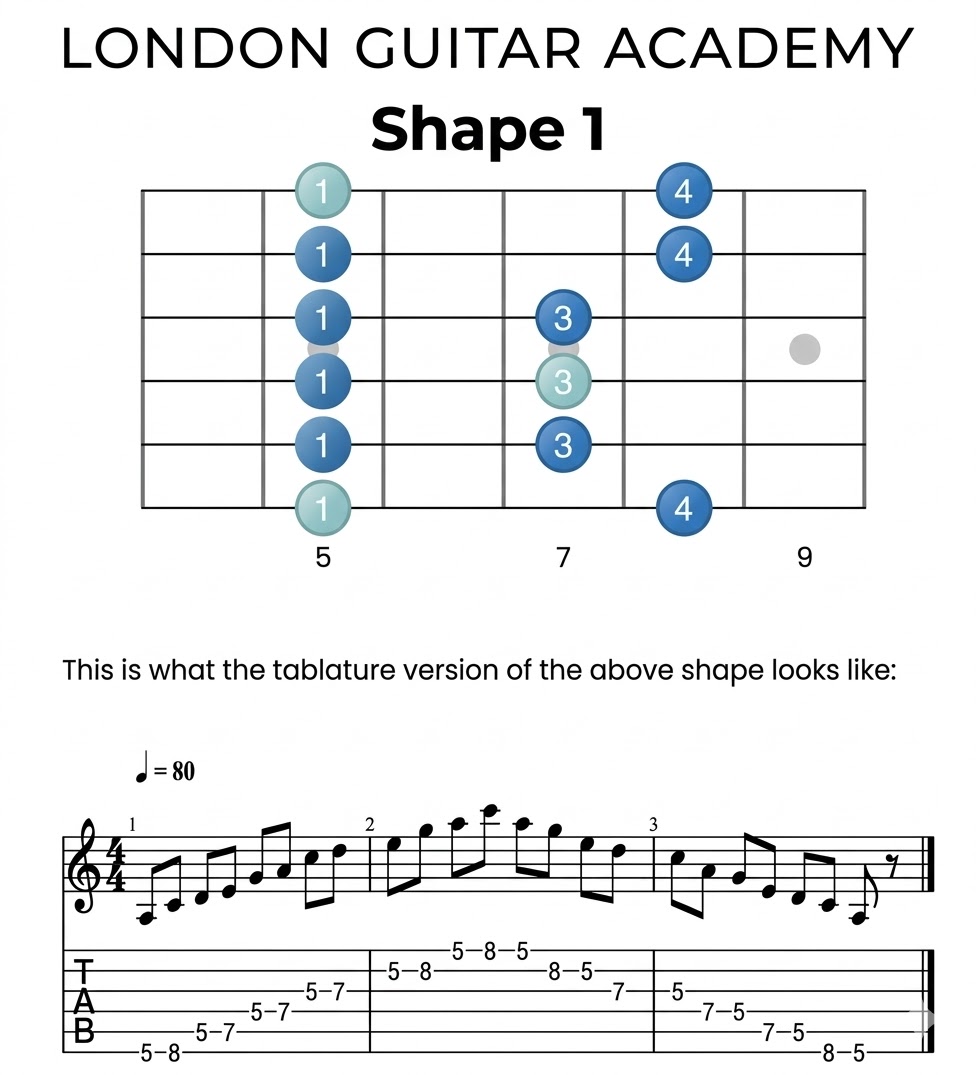
Pentatonic Box 1
In A minor pentatonic:
- Box 1 starts at the 5th fret
This is often considered the “home position” for beginner guitar solos.
How to Connect Pentatonic Boxes
Many players get stuck practicing only one scale shape.
To truly master the neck:
- Practice moving between boxes
- Slide between positions
- Play horizontally across strings
- Connect scales to chord shapes
This creates smoother and more musical solos.
Practice Exercise
Try this daily:
- Play Box 1 ascending
- Slide into Box 2
- Descend back into Box 1
- Improvise using both positions
This simple exercise builds neck freedom quickly.
6. The Best 7-Day Guitar Fretboard Memorisation Plan
Day 1: Learn the Low E String
Memorize:
- Natural notes
- Sharp/flat locations
- Landmark frets
The high E string uses the exact same notes.
Day 2: Memorize the A String
Focus on:
- Root notes
- Barre chord positions
- Octave locations
Day 3: Review the E and A Strings
These are the two most important strings for:
- Power chords
- Barre chords
- Scale roots
Day 4: Learn the D String
Start connecting octave patterns from:
- 6th string → 4th string
- 5th string → 3rd string
Day 5: Memorize the G String
Pay attention to:
- Scale visualization
- CAGED transitions
Day 6: Learn the B String
The B string is tuned differently, so many shapes shift here.
This is one of the biggest challenges for beginners.
Day 7: Full Neck Review
Test yourself by:
- Naming random notes
- Finding octaves
- Playing scales in multiple positions
- Locating chord roots instantly
Consistent repetition is the key to long-term memorization.
7. Guitar Intervals Explained: The Secret to Musical Freedom
What Are Intervals?
An interval is the distance between two musical notes.
Intervals help guitarists understand:
- Chords
- Scales
- Harmony
- Melodies
- Solo phrasing
Essential Guitar Intervals
| Interval | Half-Steps | Sound |
|---|---|---|
| Major 3rd | 4 | Bright, Happy |
| Minor 3rd | 3 | Bluesy, Emotional |
| Perfect 5th | 7 | Strong, Powerful |
Why Intervals Matter on Guitar
Learning interval shapes allows you to:
- Build chords anywhere
- Find melody notes quickly
- Create harmonies
- Solo more musically
Great improvisers think in intervals, not just scale boxes.
8. Common Guitar Fretboard Mistakes to Avoid
The B String Trap
The B string is tuned differently from the other strings.
Whenever a chord or scale shape crosses from the G string to the B string:
- Shift the pattern one fret higher
Ignoring this causes incorrect notes and broken patterns.
Getting Stuck in One Scale Box
Many guitarists never leave Pentatonic Box 1.
To avoid sounding repetitive:
- Practice on one string only
- Move horizontally across the neck
- Connect multiple positions
This develops true fretboard freedom.
Memorizing Shapes Without Understanding Theory
Shapes are useful, but theory explains why they work.
Understanding:
- Intervals
- Root notes
- Chord construction
- Scale formulas
Will help you become a far more versatile musician.
9. Daily Exercises to Master the Guitar Neck Faster
Exercise 1: Random Note Finder
Pick a random note like:
- C
- F#
- Bb
Then locate it on every string.
This builds instant note recognition.
Exercise 2: Single-String Scale Practice
Play scales using only one string.
Benefits include:
- Better ear training
- Improved note visualization
- Escaping “box pattern” thinking
Exercise 3: Octave Drills
Choose one note and find every octave across the neck.
This improves spatial awareness rapidly.
Exercise 4: Chord Tone Targeting
While soloing:
- Land on root notes
- Target 3rds and 5ths
- Connect scales to chords
This creates more musical solos.
10. How Long Does It Take to Learn the Guitar Fretboard?
Realistic Expectations
Most guitarists see major improvement within:
- 2–4 weeks of focused practice
True fretboard fluency usually develops over:
- Several months of consistent playing
The Key to Faster Progress
Spend at least:
- 10–15 minutes daily
Practicing:
- Note naming
- Octaves
- Intervals
- Scale connections
Consistency matters more than marathon practice sessions.
Frequently Asked Questions About the Guitar Fretboard
What Is the Fastest Way to Memorize the Guitar Fretboard?
The fastest method combines:
- Note memorization
- Octave shapes
- Daily repetition
- CAGED visualization
Most players improve dramatically when practicing consistently every day.
Is the CAGED System Necessary?
No, but it is extremely useful.
The CAGED system helps guitarists visualize:
- Chords
- Arpeggios
- Scales
- Neck positions
It is one of the best systems for understanding fretboard layout.
Should Beginners Learn Scales or Chords First?
Most beginners should start with:
- Basic chords
- Open string notes
- Pentatonic scales
- Fretboard memorization
This creates a balanced foundation.
Why Do Guitarists Struggle With the Fretboard?
Common reasons include:
- Practicing shapes without note names
- Staying in one scale box
- Ignoring intervals
- Inconsistent practice habits
Structured practice solves these issues over time.
The Guitar Fretboard Is a Pattern, Not a Mystery
Mastering the guitar fretboard is less about talent and more about recognizing patterns consistently.
When you understand:
- Notes
- Octaves
- Intervals
- Chord shapes
- Scale connections
The neck transforms from confusing to completely navigable.
Practice daily, stay patient, and focus on understanding rather than memorization alone. Over time, the “wall of dots” disappears — replaced by a clear musical roadmap for improvisation, songwriting, rhythm guitar, and confident lead playing.