Diatonic Harmony for Guitarists
What Is Diatonic Harmony? A Guitarist’s Guide to Chords, Keys & Progressions
Ever wondered why certain chords sound naturally pleasing together? Why some progressions pull hard toward resolution while others just sit there? Why the same four chords show up in a thousand different songs? The answer, every time, is diatonic harmony.
LGA Guitar Lessons Blog — James Stratton Guitar
Most guitarists learn harmony by rote — memorizing shapes, copying tab, following song charts — without ever seeing the system that makes those chords belong together in the first place. Diatonic harmony is that system. It’s the complete set of chords, intervals, and relationships derived from a single major or natural minor scale. Once you see it clearly on the fretboard, you stop guessing and start understanding.
Grab your guitar. This will make a lot more sense with it in your hands.
What Is Diatonic Harmony?
Diatonic harmony is music built entirely from the seven notes of one scale — the major scale, or its relative natural minor. Every interval, chord, and progression stays inside those seven notes. No outside or “chromatic” tones are involved at the foundational level.
The word diatonic comes from the Ancient Greek for “across the tones,” referring to a fixed pattern of five whole steps and two half steps. Harmonize that scale — stack notes in thirds — and you get a predictable, universal set of chords for the key.
This is the bedrock of Western music. Bach, the Beatles, blues, rock, pop, folk — the vast majority of songs lean primarily on diatonic harmony. Chromatic notes show up later for color and tension, but they’re understood as departuresfrom this diatonic baseline, not the baseline itself.
Diatonic Harmony for Guitarists
The Foundation: The Major Scale
Everything starts with the major scale’s unchanging interval pattern:
W – W – H – W – W – W – H (W = whole step / 2 frets, H = half step / 1 fret)
In C major — the simplest key, no sharps or flats:
| Scale Degree | 1 | 2 | 3 | 4 | 5 | 6 | 7 |
|---|---|---|---|---|---|---|---|
| Note | C | D | E | F | G | A | B |
Every major scale follows this exact pattern. Shift the starting note and you change key, but the internal relationships stay identical. Learn one key thoroughly and you’ve effectively learned all twelve — you’re just moving the same shape to a new starting fret.
Building Diatonic Chords
To build harmony, stack thirds above each scale degree: root + third + fifth = a triad. Do this for every note in the major scale and you get a fixed, repeating pattern of chord qualities.
In C major:
- I – C: C–E–G → C major
- ii – D: D–F–A → D minor
- iii – E: E–G–B → E minor
- IV – F: F–A–C → F major
- V – G: G–B–D → G major
- vi – A: A–C–E → A minor
- vii° – B: B–D–F → B diminished
The universal pattern — identical in every key:
I major · ii minor · iii minor · IV major · V major · vi minor · vii° diminished
Roman numerals capture the relationship, not a specific pitch — uppercase for major, lowercase for minor, a degree symbol for diminished. When musicians say “I–V–vi–IV,” they’re describing a functional shape that works in any key, on any instrument.
Try it now: play C, then G, then Am, then F on your guitar. That’s I–V–vi–IV in C major — you’ve just played thousands of pop songs’ backbone in four chords.
Seventh Chords
Stack one more third on top and the pattern extends to:
Imaj7 · iim7 · iiim7 · IVmaj7 · V7 · vim7 · viim7♭5 (half-diminished)
In C major: Cmaj7 – Dm7 – Em7 – Fmaj7 – G7 – Am7 – Bm7♭5
Diatonic Harmony on the Guitar Neck
The guitar is a uniquely visual instrument for this. Once the diatonic pattern clicks, individual chord shapes stop being isolated and become part of one connected system.
Interval map between roots:
- I to ii = 2 frets
- ii to iii = 2 frets
- iii to IV = 1 fret
- IV to V = 2 frets
- V to vi = 2 frets
- vi to vii° = 2 frets
- vii° to I = 1 fret
Know where your I chord sits, and every other chord in the key follows just by counting frets.
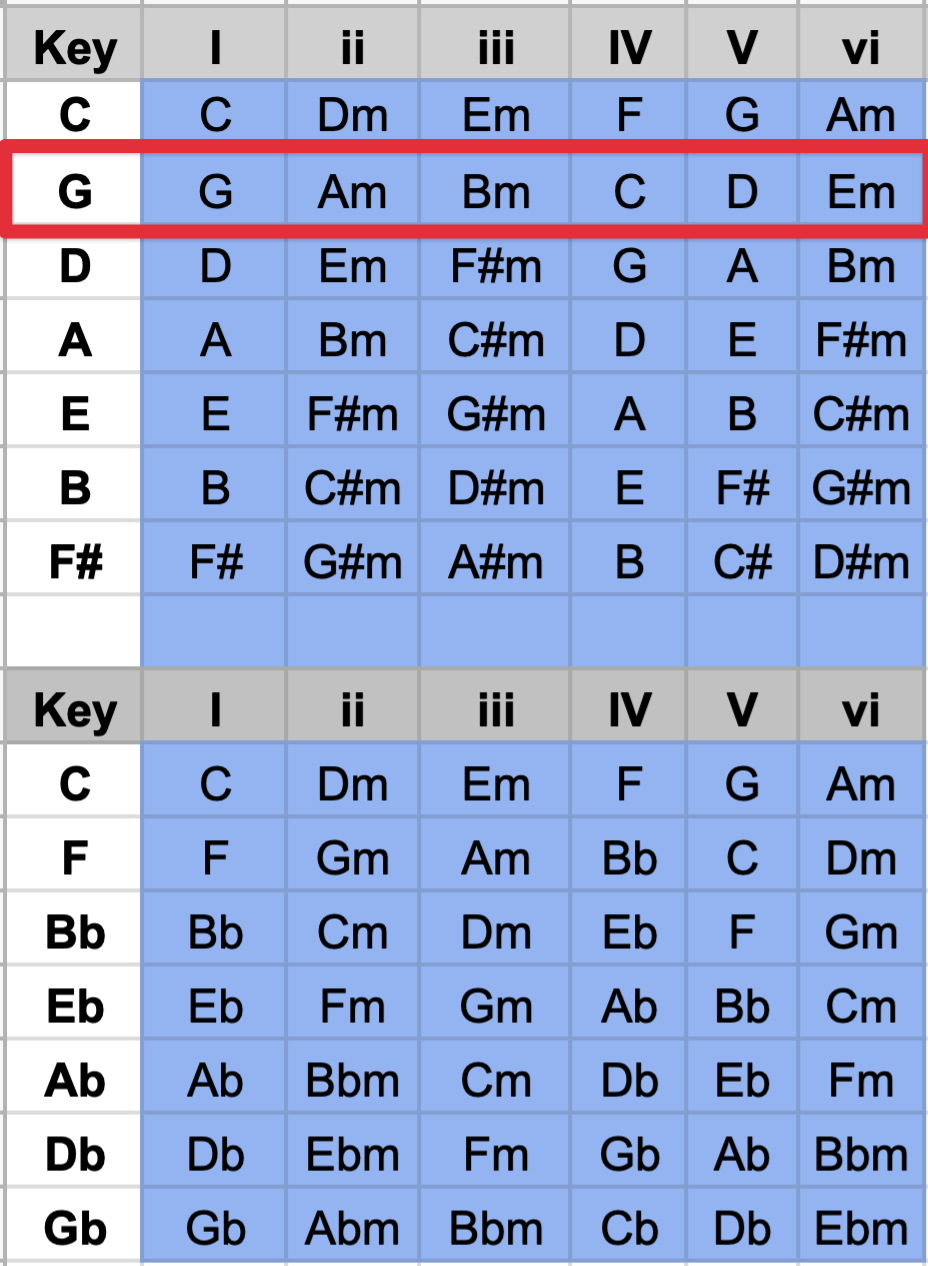
Open-position example: G major
- I = G major
- ii = A minor
- iii = B minor
- IV = C major
- V = D major
- vi = E minor
- vii° = F♯ diminished
Almost every open chord you learned as a beginner — G, Am, Bm, C, D, Em — is diatonic to G major. You’ve been playing diatonic harmony since your first week with the instrument. Now you can see why it works.
The CAGED system and barre shapes map onto these same relationships everywhere on the neck. The logic doesn’t change — only the fret position does.
Functional Harmony: What Each Chord Does
Diatonic chords aren’t a random list — each one has a job to do.
Tonic (Stability — “Home”): I, and often vi The center of gravity. Music feels resolved and complete when it lands here. The vi chord shares two notes with I and works as a gentler, more wistful tonic substitute — listen for how a song feels like it’s “arrived” but with a shadow over it when it resolves to vi instead of I.
Dominant (Tension — “Pulling Home”): V and vii° The V chord contains the leading tone (scale degree 7), sitting a half-step below the tonic and creating a strong magnetic pull back to I. Play V then I and listen to that pull resolve — that half-step tug is the sound of tension and release in Western music. vii° creates the same pull, more unstable.
Subdominant (Movement — “The Bridge”): IV and ii These move you away from home without demanding the intense resolution a dominant chord does. They share two notes and are often interchangeable — swap IV for ii in a progression and the function stays the same, only the color shifts slightly.
Golden rule of movement: Tonic → Subdominant → Dominant → Tonic. You can move freely from the tonic, but going straight from dominant back to subdominant tends to feel backwards — like skipping a step. This one principle explains why some progressions feel inevitable and others feel off.
Famous Diatonic Progressions
These show up across every genre because they follow functional logic perfectly:
- I – V – vi – IV (the modern pop standard) — countless contemporary hits share this exact shape.
- I – IV – V (blues, rock, folk foundation) — the most primal progression in Western music.
- vi – IV – I – V (emotional modern ballad) — starting on the relative minor gives it a searching, bittersweet quality before it resolves.
- ii – V – I (jazz and ultimate resolution) — especially powerful as sevenths: iim7 – V7 – Imaj7.
- I – vi – IV – V (classic doo-wop) — warm, familiar, still everywhere.
None of these leave the diatonic set. They work because they respect the scale’s internal logic — not despite ignoring it.
Relative Major and Minor
Every major scale has a relative natural minor built on its sixth degree. They share the exact same seven notes and seven chords — the only difference is which note feels like home.
- C major and A minor are relatives.
- G major and E minor are relatives.
- D major and B minor are relatives.
Shift emphasis from I to vi and you completely change the emotional color while staying fully diatonic. This is one of the most powerful — and most underused — tools available to songwriters and improvisers. Try playing the exact same four chords from “I–V–vi–IV” starting on the vi instead, and hear how the same material suddenly feels minor and searching rather than bright and settled.
Why Diatonic Harmony Transforms Your Playing
- You stop memorizing isolated shapes and start seeing one interconnected system.
- Transposition becomes trivial — move the root, keep the same relationships.
- Songwriting becomes intentional — choose functions to create hope, tension, melancholy, or resolution on purpose, not by accident.
- Improvisation becomes deliberate — you know which notes belong over each chord and which ones create the strongest pull.
- You learn songs faster — most progressions are just three or four diatonic chords in familiar patterns you’ll start recognizing by ear.
- Advanced harmony finally makes sense — chromaticism, borrowed chords, secondary dominants, and modulation are all defined by how they depart from the diatonic baseline.
- You understand why certain clashes happen — and how to use them on purpose when you want that tension.
Common Myths
“Diatonic harmony is restrictive.” It’s the foundation, not the ceiling. Great music is built on it, then colored by controlled departures from it.
“Blues and rock ignore these rules.” Most blues and rock are firmly built on I–IV–V. Blue notes are chromatic decoration layered on top of that diatonic structure, not a replacement for it.
“I play by ear, so theory is unnecessary.” Theory just names what your ear already recognizes. Naming the relationships lets you communicate them, repeat them on purpose, and expand your instincts deliberately instead of by accident.
“There are too many keys to learn.” There’s only one diatonic system. I–ii–iii–IV–V–vi–vii° is identical in every key. Learn it once, apply it everywhere.
A Practical Mastery Plan (Start in G Major)
Week 1 — Hear the qualities. Play each of the seven chords in G major slowly, one at a time. Really listen to the weight and mood of each — major sounds settled, minor sounds inward, diminished sounds unresolved and restless.
Week 2 — Map the neck. Find every chord in open position, then again around the 5th-position barre, then the 7th. Notice the relationships stay fixed while the shapes move around.
Week 3 — Think in function, not letters. Play I–IV–V–I and say “tonic, subdominant, dominant, tonic” out loud as you play, not “G, C, D, G.” Then try ii–V–I and vi–IV–I–V the same way.
Week 4 — Train your ear on function. Play the I chord, then have someone (or a looper) play a random diatonic chord from the key. Before checking, guess: is it tonic, subdominant, or dominant? You’ll start hearing the pull of V and the stability of I within a few tries.
Week 5 — Transpose everything. Move the whole system up two frets into A major. Same shapes, same relationships, same logic — only the pitch has changed. This is the moment the system stops being “G major facts” and becomes a tool you own in every key.
Quick Reference Cheat Sheet
| Degree | Quality | Function |
|---|---|---|
| I | Major (Maj7) | Tonic — Home |
| ii | Minor (m7) | Subdominant — Movement |
| iii | Minor (m7) | Mediant — Transition |
| IV | Major (Maj7) | Subdominant — Movement |
| V | Major (Dom7) | Dominant — Tension & Pull |
| vi | Minor (m7) | Relative minor / Tonic-adjacent |
| vii° | Diminished (m7♭5) | Leading tone — Strongest pull |
Golden rule of flow: Tonic → Subdominant (ii or IV) → Dominant (V or vii°) → Tonic
Alwas Remember
Diatonic harmony isn’t abstract theory homework — it’s the operating system running underneath every song you love. For guitarists, it’s the difference between wandering from shape to shape and actually seeing the map. It explains why chords belong together, why progressions resolve the way they do, how to write with emotional intention instead of guesswork, and how to improvise with confidence instead of luck.
You don’t need to master all twelve keys today. You need one simple truth: every chord in a key comes from the same seven notes, arranged in a fixed pattern of major, minor, and diminished, each with a clear job — to leave home, travel, and return.
That’s diatonic harmony. Once you truly see it on the neck, you’ll never look at the guitar the same way again.