There’s nothing that can replace the value of learning the guitar with a great guitar teacher.












Guitar Lessons in London
Anyone Can Learn, Start Today & Master The Guitar with Us
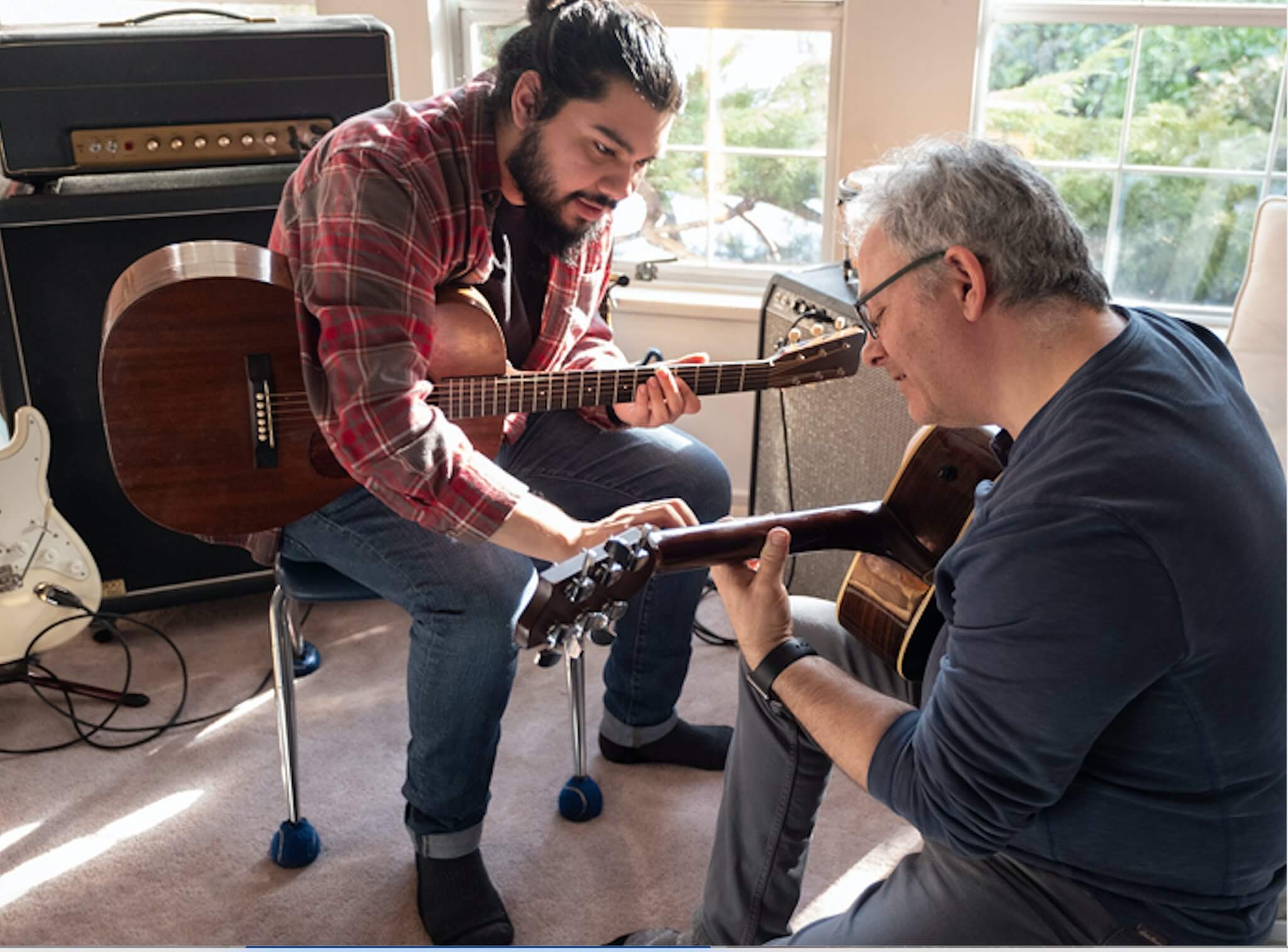
There’s nothing that can replace the value of learning the guitar with a great guitar teacher. Whether you are picking up a guitar for the first time or are an advanced player looking to break out of a rut and expand your capabilities, you need a guitar teacher who is dedicated to helping you achieve your goals.
- All Levels Welcome
- Quality guitar tuition in a relaxed atmosphere
- Lessons are available seven days a week.
- Lessons are customised to fit each student’s needs
- Learn step by step at your own pace
- Scheduling is flexible! Regular slot available
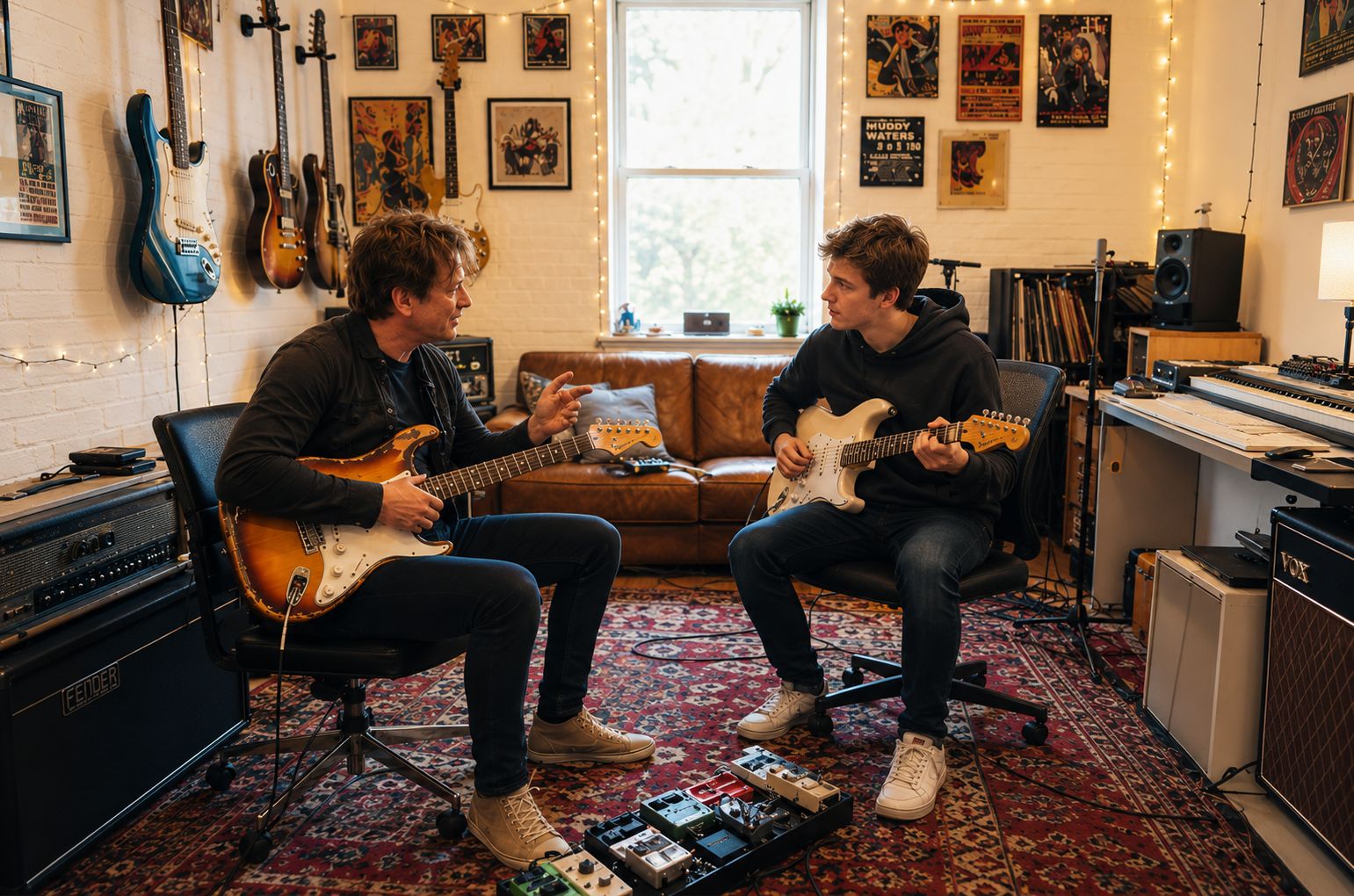
- Fully equipped studio with plenty of guitars to use
- Our amazing teachers can even travel to your home or office!
For more information and to book trial lesson at the London Guitar Academy call James 07957 230 354 or e-mail info@londonguitaracademy.com

Lesson Reviews
 "I'm two weeks into a 6 week course of 1:1 online lessons and I'm having an amazing time! James is a patient and encouraging teacher who's enthusiasm for music is contagious."
 "I took the beginner guitar course (six weeks) and loved every minute. James created a friendly, welcoming environment for our group, calling us a “band” from the start."
 "As an adult beginner, I couldn't have a better teacher than James and his brilliant London Guitar Academy Team."
 "Great lessons from a truely great teacher! I've really enjoyed every guitar lesson with James . He’s a musical mastermind and great at explaining in an easy to understand way"
 "London Guitar Academy are the best guitar teachers in London, and their guitar lessons are unparalleled."
 "London Guitar Academy is my first experience taking actual guitar lessons and I'm so glad I did i chose them! James is constantly encouraging and pushing me to improve my guitar playing abilities."
 "Excellent Guitar Academy! James is a fantastic guitar teacher located here in London, he knows music inside out and is outstanding at teaching students of all ages and abilities"
 "I recently had a guitar lesson with James which I very mucn enjoyed, giving me tips and techniques which I will carry through for a lifetime."
Kids Lessons, Beginner Lessons, Intermediate Lessons, Advanced Lessons – Friendly, Expert, Skilful London Tutors
The London Guitar Academy is London’s go-to for top quality, professional guitar tuition! Our teaching studio is located in the heart of Kilburn, with excellent links to both Overground and Underground services.
Our mission is to provide a warm, friendly environment for aspiring musicians of all ages and ability to come and hone their guitar skills. Our roster of professional tutors are ready to help you level up your shredding skills and help you have lots of fun along the way!
Here at The London Guitar Academy we have an exceptional team of tutors who specialise in all kinds of exciting styles and genres. From blues and bebop to funk and flamenco, we have the tutor for you that can help you reach your musical goals!
We offer both acoustic and electric guitar lessons, for all ages and abilities across all genres. So whoever you are and whatever style of guitar you wish to pursue, we will be able to match you with the perfect tutor that will provide you with specialised and tailored tuition specific to you. If you prefer a more social experience, we also offer group lessons as well as one to one tuition, giving you the flexibility to learn in an environment which is right for you!
Guitar Lessons For Beginners & Intermediates
Guitar Lessons For Beginners
Our beginner lessons are perfect for first time guitarists! In these lessons we will introduce you to the fundamental techniques of guitar, such as chords, scales and some beginnings of musical theory, all whilst focusing on the music you know and love. We always create a fun and welcoming environment for our students and our aim is to help you learn efficiently, at a pace that is right for you.
Guitar Lessons for Intermediates
For guitarists who have some existing experience and have been playing for up to a year. Our intermediate lessons will start to introduce you to a wider variety of genres and some more complex chords and scales, all while expanding on your music theory along the way. We will be focusing on making you feel confident and comfortable on your instrument, by giving you the tools to expand on your previous experience and achieve your goals on the guitar.
Please have a look at the wide range of guitar lessons we offer. If you have any questions, send us an email or give us a call and we would love to help you find the perfect lesson for you!
Discover the Joy of Playing with Our Guitar Lessons in London!
Have you ever dreamed of strumming your favorite tunes on a guitar, but didn’t know where to start? Or perhaps you’ve already got some experience but want to take your skills to the next level? Whether you’re a complete beginner or an aspiring guitar hero, our guitar lessons in London are designed to make your musical journey fun, supportive, and deeply rewarding.
Why Choose Our Guitar Lessons?
Learning to play the guitar should be an enjoyable experience, not a daunting task. That’s why our lessons are crafted to be as engaging and supportive as possible. Imagine walking into a room full of like-minded people, all eager to learn and grow together. The atmosphere is relaxed, the vibes are positive, and the focus is on having fun while mastering the art of playing the guitar.
Group Lessons with Individual Attention
One of the best things about our guitar lessons is the social aspect. Our classes are taught in groups, which means you’ll be surrounded by fellow learners who share your passion for music. Group learning creates a lively and motivating environment where you can connect with others, share tips, and even jam together. But don’t worry about getting lost in the crowd—our professional guitar tutors make sure you receive individual feedback and guidance every step of the way.
You’ll be amazed at how quickly you progress when you’re having fun and feel supported by both your tutor and your classmates.
Our Lesson Levels: Find Your Perfect Fit
We offer guitar lessons at two levels to ensure that everyone, from complete beginners to those with a bit more experience, finds the right starting point.
Guitar Lessons for Beginners
If you’re picking up a guitar for the first time, this is the course for you. We start with the basics, introducing you to fundamental guitar techniques that will form the foundation of your playing. You’ll learn how to strum chords, pick out melodies, and even read music—don’t worry if that sounds intimidating, we make it easy and fun! By the end of the course, you’ll be playing simple songs and feeling confident with your guitar.
Guitar Lessons Level 2
Ready to take it up a notch? Our Level 2 course is perfect for those who’ve completed the beginner lessons or have a bit of prior experience. Here, we dive into a wider range of musical genres, exploring more complex chord sequences, strumming patterns, and playing techniques. You’ll start to develop your own style as we encourage creativity and self-expression in your playing. It’s all about taking your skills to the next level while continuing to enjoy the process.
Specialized Courses: Dive into the Blues
For those who feel a special connection to blues and jazz, we offer a dedicated Blues Guitar course. This is where you can really dig into the soulful sounds of blues and jazz standards. Whether you’re drawn to the raw emotion of blues or the intricate improvisations of jazz, our course will guide you through the key techniques and styles. You’ll learn to improvise, understand the nuances of blues scales, and even develop your own signature sound. It’s a deep dive into a genre that’s as rich in history as it is in musical complexity.
Expand Your Horizons with Music Production Courses
Playing the guitar is just the beginning of your musical journey. For those interested in taking their skills to the next level, we also offer a range of music production courses. Imagine not just playing your guitar, but recording it, mixing tracks, and producing your own songs! Our music production courses cover everything from the basics of digital audio workstations (DAWs) to advanced techniques in mixing and mastering. It’s the perfect way to complement your guitar playing and expand your musical repertoire.
The Benefits of Learning Guitar with Us
When you join our guitar lessons in London, you’re not just signing up for a course—you’re joining a community. Here’s what you can expect:
1. A Supportive Learning Environment
Learning something new can be challenging, but with our supportive tutors and friendly classmates, you’ll always feel encouraged. We’re here to help you overcome any obstacles, celebrate your progress, and keep you motivated.
2. A Fun and Engaging Approach
We believe that the best way to learn is by having fun. Our lessons are designed to be enjoyable, with plenty of opportunities to play, experiment, and discover your own musical voice.
3. Flexible Learning Options
We understand that everyone has a different schedule, so we offer lessons at various times throughout the week. Whether you’re a night owl or an early bird, you’ll find a class that fits your lifestyle.
4. Continuous Growth
Our courses are structured to ensure steady progress. Whether you’re moving from beginner to intermediate or exploring new genres like blues and jazz, there’s always something new to learn and master.
5. Real-World Application
We don’t just teach you how to play songs; we teach you how to understand music. Our lessons cover music theory, technique, and improvisation, giving you the tools you need to play with confidence and creativity.
6. A Pathway to Performance
For those who dream of playing in front of an audience, our lessons can help you get there. We offer opportunities to perform, whether in class or at local events, helping you build confidence and stage presence.
Join Our Guitar Community Today
Learning to play the guitar is one of the most rewarding experiences you can have. It’s a journey that brings joy, challenges, and a deep sense of accomplishment. Whether you’re strumming your first chord or perfecting a blues riff, there’s always something new to discover. And with our guitar lessons in London, you’ll be part of a vibrant community that shares your passion for music.
So why wait? Pick up that guitar and join us today. Whether you’re looking to learn something new, improve your skills, or just have fun making music, our lessons are the perfect place to start. With our experienced tutors, supportive environment, and a curriculum designed to keep you engaged, you’ll be playing your favorite songs in no time.
Sign up now and take the first step on your musical journey. The guitar is waiting for you—and so are we!
The 5-Minute Daily Habit That Will Transform Your Guitar Skills
Time is the number one excuse most aspiring guitarists give for slow progress—but what if just five minutes a day could lead to serious improvement? Whether you’re a beginner stuck on chords or an intermediate player trying to break out of a rut, the right kind of focused daily habit can create long-term transformation.
In this article, you’ll discover a powerful, time-efficient practice method that targets technique, musicality, and consistency—perfect for guitarists of all levels.
Why 5 Minutes Can Make a Huge Difference
It’s easy to dismiss five minutes as “not enough time,” but consistency always beats intensity. Practising for five focused minutes every day builds:
-
Muscle memory
-
Finger strength and control
-
Mental engagement with your instrument
-
Confidence through daily wins
Most importantly, it builds a habit. And that’s where the magic happens.
What Is the 5-Minute Daily Habit?
This isn’t about random noodling or mindless scale running. The habit is a highly focused micro-practice that targets a core skill in one of three key areas:
-
Technique
-
Ear training
-
Creativity
Let’s break down each.
1. Technique: Precision Over Speed
Pick a small technical element—such as alternate picking, chord switching, or hammer-ons—and focus on it with maximum clarity and intention.
Example Exercise:
-
Chord Switch Drill:
Set a timer for 5 minutes. Practice switching between two chords (e.g., G and C) slowly and perfectly. Aim for accuracy, not speed.
Over time, this builds:
-
Smoother transitions
-
Less tension in the hands
-
Clean sound—especially important for acoustic players
2. Ear Training: Play What You Hear
Spend 5 minutes daily trying to replicate simple melodies by ear. This strengthens your musical ear and builds a direct connection between what you hear and what you play.
Example Exercise:
-
Listen to a short melody (a jingle, TV theme, or simple riff).
-
Try to match it on your guitar by ear—no tabs allowed!
Benefits:
-
Improves improvisation
-
Enhances songwriting
-
Builds confidence in playing with others
3. Creativity: Micro Improvisation
Use a backing track, loop pedal, or metronome and spend 5 minutes improvising a short melody or riff. No overthinking—just exploration.
Example Exercise:
-
Pick one scale (e.g., A minor pentatonic).
-
Create a mini solo with just 3–5 notes.
-
Focus on phrasing, bends, and rhythm—not speed.
Over time, this habit unlocks:
-
Your unique voice on the guitar
-
Better melodic awareness
-
Greater enjoyment of your instrument
How to Stick With It
Consistency is everything. Here’s how to keep the habit alive:
Set a Daily Trigger
Tie the habit to something you already do—like brushing your teeth or making coffee.
⏱ Use a Timer
Keep it short. Knowing it’s just 5 minutes makes it easier to start—and you often end up playing longer.
Track Progress
Keep a simple practice log. Write down what you practised, what improved, and what you’ll do next.
Stay Inspired
Watch a short YouTube solo, learn a cool lick, or listen to a favourite song before practising. This keeps motivation high.
The Compound Effect: What Happens After 30 Days?
Practising for five minutes a day for a month adds up to 2.5 hours of focused effort. But because you’re building consistency and depth, the results are exponential:
-
Faster chord changes
-
Better rhythm and control
-
Stronger connection between ears and fingers
-
Creative breakthroughs in your playing
In fact, many students report more growth from a month of 5-minute daily sessions than from occasional 1-hour marathons.
Bonus: 5-Minute Habit Examples by Skill Level
| Skill Level | Focus Habit | Example |
|---|---|---|
| Beginner | Chord transitions | G–C–D clean switch drill |
| Intermediate | Melody by ear | Pick out a familiar vocal line |
| Advanced | Modal soloing | 5-minute Phrygian lick improv |
Last Chorus
You don’t need to wait for the perfect moment or hours of free time to improve on guitar. All it takes is a simple, repeatable, focused habit—just five minutes a day.
Start today. Set your timer, pick your focus, and show up for yourself. Your future playing self will thank you.
The One Technique That Will Revolutionize Your Guitar Sound
Are you endlessly chasing the perfect tone—swapping pedals, adjusting amp settings, and investing in new gear—only to find that something still feels… missing? You’re not alone. Many guitarists spend years (and small fortunes) looking for that elusive magic that transforms their playing from average to extraordinary.
But here’s the twist: the real game-changer isn’t something you can buy. It’s not another effects pedal or custom pickup—it’s something entirely within your reach. It’s called dynamic control, and once you master it, your guitar will start to speak in ways you never imagined.
What Is Dynamic Control—and Why Should You Care?
Dynamic control is the art of shaping volume, tone, and feel with your hands, in real time. It’s the subtle rise and fall in intensity, the contrast between whisper-quiet fingerpicking and bold, resonant strumming. It’s what gives your playing life.
Imagine a storyteller who only shouts, or a singer who sings every note the same way—flat, predictable, and emotionless. Without dynamics, music loses its soul. With them, even simple phrases become deeply expressive.
Why Dynamic Control Transforms Your Sound
It Adds Emotion and Character
With dynamic control, you don’t just play notes—you tell stories. A soft, trembling passage can evoke longing or intimacy, while a sudden swell in volume can send chills down your spine. Your guitar becomes an extension of your emotional voice.
It Clarifies Your Tone
Uniform volume can muddy your sound, especially in group settings. Dynamics let you carve space for your notes, giving each phrase its own identity. Rhythm parts breathe. Lead lines sing. Everything sounds more refined.
It Elevates Your Musicality
Great music flows like a conversation—there’s tension and release, light and shade. Dynamics let you shape phrases musically, giving your playing a natural, human feel. This subtlety is what separates “good” from “great.”
⚡ It Makes Your Gear Work Harder for You
A dynamic touch doesn’t just sound better—it interacts beautifully with your gear. Tube amps, overdrive pedals, compressors, and delay units all respond differently based on how hard (or soft) you play. You’ll unlock new textures from the same setup, simply by touching the strings differently.
It Works Across Every Genre
From the soft sway of jazz to the punch of metal, dynamic control is the invisible thread that connects all great players. Whether you’re fingerpicking folk tunes or delivering blazing solos, this technique is essential.
How to Develop Dynamic Control (Without Overcomplicating It)
It doesn’t take hours of practice each day—it takes awareness and intention. Here’s how to get started.
1. Master the Picking Hand
Your strumming or picking hand is where most of the dynamic magic happens.
-
Pick Attack: Play the same note at five different intensities, from the softest whisper to a bold blast. Learn to feel the spectrum.
-
Pick Angle & Hand Placement: Angling your pick or shifting your picking location (bridge vs neck) can change both tone and dynamics.
-
Use Your Fingers: Experiment with fingerpicking even if you’re used to a pick. Your fingers offer a softer, more nuanced dynamic range.
✋ 2. Refine the Fretting Hand
Though less obvious, your fretting hand shapes expression too.
-
Fret Pressure: Lighter pressure can create a gentler sound; firmer grip helps sustain.
-
Vibrato and Bends: How you vibrate or bend a note influences its emotional weight. Slow, wide vibrato? Smooth and soulful. Fast and narrow? Urgent and edgy.
-
Muting Techniques: Palm muting and fret-hand muting help sculpt rhythm and space between notes.
3. Daily Exercises to Build Control
The Volume Swell Drill: Play a note or chord. Slowly increase volume from barely audible to bold, then gently fade it back. This teaches smooth transitions.
Dynamic Scales: Run scales where each note is gradually louder (ascending) or softer (descending). Then reverse.
Accents Practice: Take a simple riff and emphasize every second or third note. You’ll start hearing music as phrasesrather than patterns.
Record Yourself: It’s hard to fix what you can’t hear. Record your practice, listen closely, and identify where your dynamics shine—or fall flat.
Think in Shades, Not Extremes
Dynamic control isn’t just about going from loud to soft. It’s about micro-movements—gentle swells, light ghost notes, tiny accents that make your playing breathe. Like the painter who uses not just bold brushstrokes but delicate shading, you want to craft your sound with nuance.
Weaving Dynamics into Your Everyday Playing
Don’t treat dynamics as an isolated exercise. Embed them into everything you do.
-
While Learning a Song: Ask yourself: Where should I build intensity? Where should I pull back?
-
During Improvisation: Let the solo breathe. Start soft, build gradually, and let phrases unfold naturally.
-
In a Band: Learn when to step forward—and when to leave space. Dynamics aren’t just about you—they’re about the whole mix.
The Real Secret? You Already Have Everything You Need
Dynamic control doesn’t require a new pedal or guitar. It’s about learning to listen, feel, and react. As you develop this skill, you’ll find that even your basic gear starts to sound better. Your music becomes more emotional, your playing more personal.
This is the one technique that professional guitarists all have in common—and the one that many beginners overlook.
Last Chorus
If you’ve ever felt like your playing sounds robotic or flat—even when your notes are technically correct—chances are, you’re missing dynamic control. But the good news? It’s a technique that’s 100% free, completely learnable, and incredibly rewarding.
So next time you pick up your guitar, don’t just chase speed or flashy licks. Take a breath, lean into your sound, and explore the space between soft and loud. That’s where the soul of your music lives.
Master dynamics—and watch your guitar sound come alive.
Why Scales and Chords Harmonise So Well Together
The Musical Magic Behind Guitar Playing
If you’ve ever played a few chords on the guitar and wondered how they seem to “fit” with certain notes—or why some solos sound like they belong with the rhythm underneath—you’re already tapping into one of the most powerful relationships in music: scales and chords.
Understanding how these two elements work together isn’t just for advanced players or music theorists. It’s for anyone who wants to play guitar more confidently, write songs more creatively, and improvise more freely. The best part? It’s easier and more achievable than it sounds.
Let’s break it down in simple, practical terms.
1. What Are Scales and Chords, Really?
Before we explore how they harmonize, let’s define what they are in the simplest way possible.
-
Scales are sequences of musical notes in a specific order. For example, the C major scale includes the notes: C, D, E, F, G, A, B.
-
Chords are groups of notes played together, usually three or more, built from scales. A C major chord, for instance, uses the 1st (C), 3rd (E), and 5th (G) notes from the C major scale.
So, chords are like little teams of notes taken directly from scales. That’s why they naturally sound good together—they’re made from the same ingredients.
2. Scales Feed Chords, Chords Guide Scales
Here’s the beautiful part: when you know the key (the scale), you unlock a full menu of chords that sound harmonious together. And when you know the chords in a song, you can use their parent scale to choose lead notes, riffs, or solos that sound like they belong.
Let’s say a song is in the key of G major. That scale gives you a collection of chords that are most likely to appear:
-
G major
-
A minor
-
B minor
-
C major
-
D major
-
E minor
-
F# diminished
Now imagine you want to solo or improvise over these chords. Guess what? You can safely use the G major scale and it will sound great, because it contains all the notes those chords are built from.
3. The Musical Map: Diatonic Harmony
This relationship between scales and chords is known as diatonic harmony—a fancy term for something super useful. It simply means the chords and the melodies come from the same scale (or key), which gives the song a coherent sound.
You don’t need to memorise every scale or chord in music to get started. Begin with just a few keys—like C major or A minor—and explore their common chords. This is how you build fluency, one step at a time.
4. Why This Matters for Guitarists
Knowing how chords and scales relate gives you powerful skills:
-
Improvisation: When you know what scale fits a chord progression, you can solo with confidence.
-
Songwriting: Want to write a chord progression and a melody? Knowing the parent scale makes this process smoother and more musical.
-
Transposing: Want to move a song to a different key? Understanding scales makes transposing chords and riffs much easier.
-
Learning by ear: Recognising scale patterns in melodies helps you pick out songs faster, even without sheet music.
5. Practical Example: The Key of C Major
Let’s say you’re playing these chords: C – F – G. These are known as the I–IV–V chords in the key of C major.
The C major scale is:
C – D – E – F – G – A – B
Now look at the chords:
-
C major = C, E, G
-
F major = F, A, C
-
G major = G, B, D
All those notes come from the C major scale. That’s why they sound so smooth together! And if you want to solo over them, playing any notes from the C major scale will sound natural.
6. Minor Keys and Mood
Scales aren’t all major and happy—minor scales bring a more emotional, melancholic feel. For example:
-
The A minor scale is: A, B, C, D, E, F, G
-
Its common chords are: Am, Bdim, C, Dm, Em, F, G
Just like with major keys, the chords in a minor key are built from its scale. That’s why the sad-sounding A minor chordand the dreamy F major chord still work well together—they live in the same musical house.
7. Scale Shapes on Guitar: Making It Achievable
On the guitar, scales aren’t just ideas—they’re shapes. Here are two to get you started:
-
C major open position: Uses open strings and sounds bright and natural.
-
Pentatonic scale (e.g., A minor): A 5-note scale that’s a favourite for solos—easy to learn, hard to mess up.
Learning one shape at a time is the best way forward. Don’t rush to memorise them all. Instead, play them alongside familiar chords and listen to how they interact.
8. Putting It Into Practice: Try This
Here’s a simple exercise you can try today:
-
Pick a key—let’s say G major
-
Play the chords G, C, and D (I–IV–V in G major)
-
Now play the G major scale (G, A, B, C, D, E, F#)
-
Try humming or picking notes from the scale while strumming the chords
-
Listen for which notes sound strong over each chord
You’re now hearing the harmony between scales and chords in real time. That’s the magic of music theory made real.
9. Why This Empowers Every Guitarist
Whether you’re just starting out or returning to guitar after a break, this knowledge gives you:
-
Freedom: No more guessing what to play
-
Confidence: You understand what works and why
-
Creativity: You can build your own musical ideas with purpose
Best of all, this knowledge is inclusive. You don’t need classical training, expensive lessons, or a background in music theory. Just a guitar, a bit of curiosity, and a willingness to play.
We Say: Harmony in Action
Scales and chords aren’t just theoretical ideas—they’re tools for unlocking emotion, expression, and connection. When you understand how they fit together, you unlock a language that lets you speak through your strings.
So keep strumming, keep exploring, and remember: you don’t need to be perfect, you just need to begin. The harmony is already inside you.
How to Improve Chord Change Fluidity and Build Speed on Lead Guitar
The Encouraging Guide to Playing Faster, Smoother, and With More Confidence
Firstly
Changing chords smoothly and picking fast leads are two of the biggest challenges for beginner and intermediate guitarists alike. Whether you’re strumming your first acoustic ballad or tearing through a bluesy solo, you’ve likely hit those moments where your fingers just don’t move fast enough—or where your transitions feel clunky, tense, and frustrating.
But here’s the truth: every great guitarist started exactly where you are.
The difference? They stuck with it, practiced with purpose, and trained their fingers like athletes. The good news? So can you.
This article is your friendly, encouraging guide to unlocking fluid chord transitions and lightning-fast lead playing. It’s packed with step-by-step techniques, easy-to-implement exercises, and inspiring tips for building dexterity, rhythm, speed, and confidence—without stress or overwhelm.
Whether you’re just starting out or you’re returning to guitar after a break, this is for you.
1. The Psychology of Fluid Playing
Before diving into drills and techniques, it’s essential to acknowledge the mental game of guitar playing.
- Growth Mindset Matters: View mistakes as learning opportunities. Every buzzed string or slow change is part of progress.
- Micro-Wins: Track small victories—holding a chord cleanly or speeding up by 5 bpm. Progress builds motivation.
- Visualisation: Imagine transitions before playing them. This primes your brain-muscle connection.
- Remove Pressure: You’re not competing with anyone. Music is a journey, not a race.
- Consistency Beats Intensity: Practising for 15 minutes a day is more effective than cramming once a week.
Adopt a mindset of curiosity and compassion. Let practice be a space of exploration.
2. Finger Mechanics for Smooth Chord Changes
- Anchor Fingers: Identify fingers common to two chords and leave them in place. E.g., the ring finger between G and D.
- Minimum Movement: Lift only as high as necessary. Keep fingers close to the fretboard.
- Chord Visualisation: Picture the next chord before moving.
- Drill Chord Pairs: Practice two chords at a time in loops. E.g., C to G, G to D, Em to Am.
- Metronome Mastery: Set a slow tempo (e.g., 60 bpm) and change chords on each bar. Gradually increase speed.
Practice Tip: Try a “4-chord loop” using G – D – Em – C. Stay relaxed and focused on accuracy.
3. Relaxation and Tension Awareness
Keywords: relaxed guitar playing, guitar finger tension, avoid strain guitar
Tension is the enemy of speed and fluidity. Train your body to stay loose.
- Common Tension Traps: Clenched thumb, tight shoulders, rigid pick grip.
- Stay Grounded: Sit with feet flat, guitar resting comfortably. Avoid leaning or tensing the neck.
- Breathing Awareness: Take slow breaths during tough transitions to reset your nervous system.
- Pre-Practice Stretches: Shake out your hands, roll your shoulders, gently stretch fingers.
- Frequent Breaks: Practice in 5-10 minute segments to prevent fatigue.
4. Essential Picking Techniques for Speed and Precision
- Alternate Picking: Down-up-down-up motion. Fundamental for speed and balance.
- Economy Picking: Combines alternate with directional picking—useful for scale runs.
- Pick Grip: Loose but controlled. Let the wrist do the work, not your forearm.
- Isolate Strings: Practice one-string and two-string patterns before scaling up.
- Use a Metronome: Count each note evenly. E.g., 4 notes per beat at 60 bpm.
Practice Tip: Try a 3-notes-per-string scale in G major. Focus on precision before speed.
️ 5. Building Speed with Slow Practice
Keywords: guitar speed training, play guitar faster, improve picking speed
- Slow is Fast: Practise slowly to ingrain accuracy. Speed grows from clean repetitions.
- Loop Tricky Bars: Find the note or transition causing issues and isolate it.
- Incremental Tempo: Raise the metronome by 5 bpm only after nailing a tempo.
- Time Before Tempo: Prioritise rhythmic accuracy over rapid speed.
- Use Tools: Apps like Guitar Pro or Anytune help slow down backing tracks without changing pitch.
6. Combining Chords and Lead Playing
- Fill Between Chords: Play scale notes between chord changes for musicality.
- Example Progression: C – G – Am – F with pentatonic fills.
- Scales Over Chords: Match scale positions to chord roots for fluid playing.
- Phrase With Purpose: Think of lead lines as mini-melodies, not just speed runs.
- Train Transitions: Move from strumming to picking within a bar.
7. Building Repetition Into Your Routine
Keywords: guitar practice routine, guitar repetition, daily guitar habits
- Set a Timer: Use 5-minute drills for chord changes, scale picking, finger stretches.
- Repeat With Intention: Avoid mindless looping. Focus on tone, timing, and relaxation.
- Track Progress: Record short videos weekly. Celebrate subtle improvements.
- Daily Habits: Practice at the same time each day to build muscle memory.
- Mix It Up: Rotate exercises to prevent boredom and encourage well-rounded skill.
8. The Encouraging Roadmap—Your 4-Week Plan
Keywords: guitar practice plan, improve fast on guitar, beginner guitarist roadmap
Week 1:
- Practice 2 chord pairs (e.g., G–C, D–Em)
- One-string alternate picking
- Stretching + relaxation awareness
Week 2:
- Add metronome to chord loops
- Two-string pentatonic exercises
- Combine strumming and basic fills
Week 3:
- Practice full chord progressions
- Insert lead fills in transitions
- Add tempo with alternate picking
Week 4:
- Practice full songs combining rhythm and lead
- Record yourself daily
- Reflect and identify next goals
Takeaways
Progress on the guitar is never linear. Some days feel slow, others spark joy. But every moment you pick up your instrument, you build muscle, memory, and music.
Celebrate your wins. Forgive your fumbles. Stay consistent.
Speed comes through softness. Fluidity flows from freedom. And your guitar journey is uniquely yours.
Keep strumming. Keep picking. You’re doing better than you think.