The Ultimate 20-Week Guitar
The Ultimate 20-Week Beginner Guitar Learning Journey: From Zero to Hero
Learn Guitar Step by Step — Even If You’ve Never Played Before
Written By James Stratton 18/5/2026
There’s something unforgettable about picking up a guitar for the first time. The strings feel unfamiliar, your fingers stumble awkwardly, and every chord seems impossible. But then something incredible happens.
A few weeks later, you play your first real song.
A few months later, you can switch chords smoothly, strum confidently, and even improvise simple solos. That transformation — from complete beginner to real guitarist — is exactly what this 20-week guitar roadmap is designed to help you achieve.
Whether you’re 15 or 65, learning guitar is one of the most rewarding skills you can develop. It improves creativity, sharpens memory, reduces stress, and gives you a lifelong creative outlet. Most importantly, guitar is accessible. You don’t need expensive gear, years of lessons, or natural talent to get started.
You simply need:
- A guitar
- A clear plan
- Consistent practice
This guide gives you all three.
By the end of these 20 weeks, you’ll know:
- Essential beginner guitar chords
- Strumming and rhythm techniques
- Fingerpicking basics
- Pentatonic scales and improvisation
- Barre chords
- Music theory fundamentals
- How to play complete songs confidently
Let’s begin your guitar journey.
The Ultimate 20-Week Guitar
Phase 1: Building the Foundation (Weeks 1–4)
Week 1: Learn the Parts of the Guitar and Proper Positioning
Before you play music, you need to understand your instrument.
Learn Guitar Anatomy
Familiarise yourself with:
- Headstock
- Tuning pegs
- Nut
- Neck
- Frets
- Fretboard
- Strings
- Bridge
- Soundhole (acoustic)
- Pickups (electric)
Knowing these terms makes learning dramatically easier.
Master Proper Guitar Posture
Good posture prevents bad habits and injuries.
Correct Beginner Guitar Position:
- Sit upright
- Rest the guitar on your dominant leg
- Keep the neck angled slightly upward
- Relax your shoulders
- Place your thumb gently behind the neck
Avoid gripping the neck too tightly.
Learn Standard Guitar Tuning
The standard tuning is:
E – A – D – G – B – E
A simple memory trick:
“Eddie Ate Dynamite, Good Bye Eddie.”
Always tune your guitar before practising.
Week 1 Practice Goal
- Practice time: 15–20 minutes daily
- Focus:
- Holding the guitar comfortably
- Picking open strings
- Tuning accurately
Week 2: Learn Your First Guitar Chords
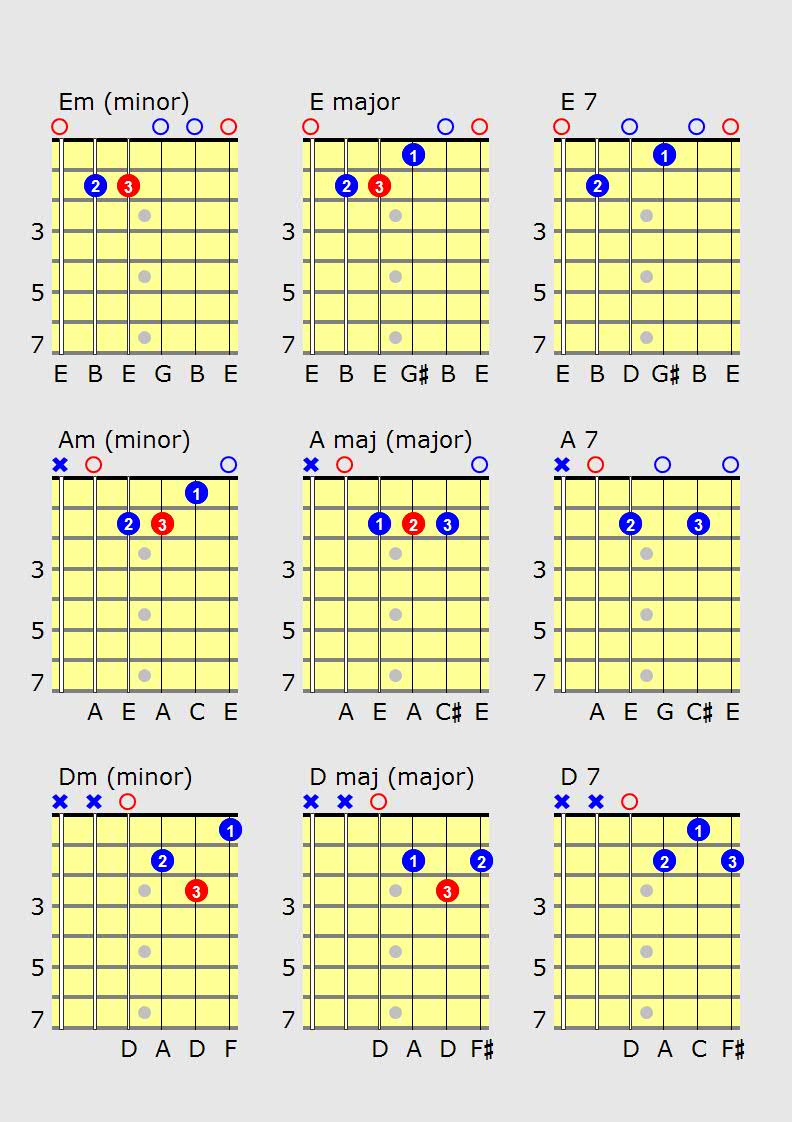
This week introduces your first beginner guitar chords:
- E minor (Em)
- A minor (Am)
- E major (E)
These chords are easy to learn and sound great together.
How to Play E Minor (Em)
Place:
- Middle finger on 2nd fret of A string
- Ring finger on 2nd fret of D string
Strum all six strings.
How to Play A Minor (Am)
Place:
- Index finger on 1st fret of B string
- Middle finger on 2nd fret of D string
- Ring finger on 2nd fret of G string
Avoid strumming the low E string.
How to Play E Major (E)
Place:
- Index finger on 1st fret of G string
- Middle finger on 2nd fret of A string
- Ring finger on 2nd fret of D string
Strum all strings.
Beginner Chord Transition Tip
Practice switching slowly between:
- Em → Am
- Am → E
- Em → E
Clean sound matters more than speed.
Week 2 Practice Goal
- 20 minutes daily
- Focus on:
- Memorising chord shapes
- Smooth transitions
- Avoiding buzzing strings
Week 3: Add G Major and D Major
Now your chord library expands with:
- G major
- D major
These are among the most used chords in modern music.
How to Play G Major
Place:
- Middle finger on 3rd fret low E
- Index finger on 2nd fret A
- Ring finger on 3rd fret high e
How to Play D Major
Place:
- Index finger on 2nd fret G
- Ring finger on 3rd fret B
- Middle finger on 2nd fret high e
Only strum the top four strings.
Songs You Can Play With These Chords
You can now play simplified versions of:
- Pop songs
- Folk songs
- Rock classics
- Country progressions
Week 3 Practice Goal
- 25 minutes daily
- Practice:
- Chord transitions
- Simple down strumming
- Playing along with slow songs
Week 4: Play Your First Full Song
This is where guitar becomes exciting.
By now, you’re ready to play simple beginner songs such as:
- “Knockin’ on Heaven’s Door”
- “Horse With No Name”
- Simplified “Wonderwall”
Learn Basic Guitar Strumming Patterns
Start with:
- Down strums
- Down-up strums
- Consistent rhythm
Beginner Rhythm Tip
Tap your foot while playing.
This develops timing naturally.
Week 4 Practice Goal
- 25–30 minutes daily
- Learn one complete song from start to finish
Phase 2: Building Real Guitar Skills (Weeks 5–9)
Week 5: Learn C Major and A Major
This week adds:
- C major
- A major
Why C Major Matters
C major appears in thousands of songs.
It’s often the first truly challenging beginner chord because of the finger stretch.
Week 5 Practice Goal
- 30 minutes daily
- Focus heavily on:
- C ↔ G transitions
- Clean chord shapes
- Relaxed finger movement
Week 6: Beginner Fingerpicking Basics
Fingerpicking unlocks:
- Folk music
- Acoustic ballads
- Singer-songwriter styles
- Classical techniques
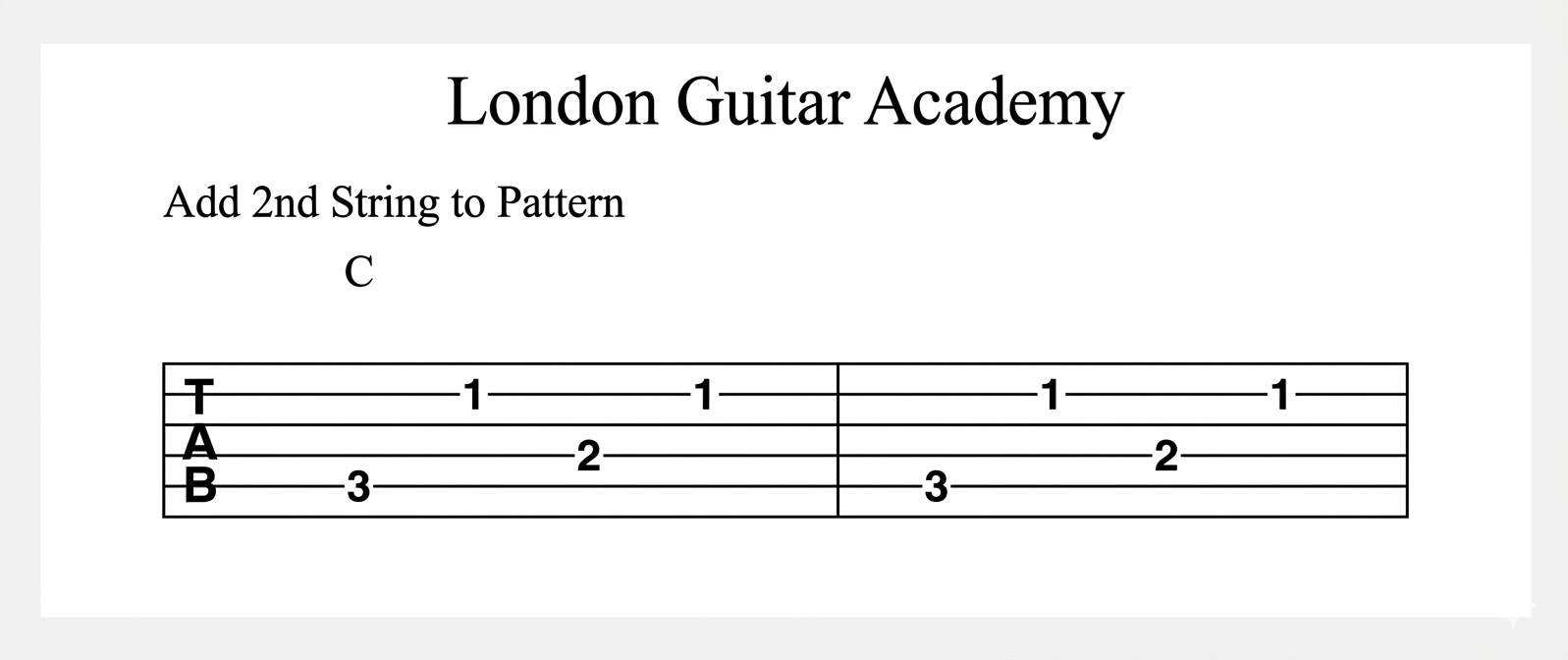
Learn Simple Travis Picking
Travis Picking
Assign:
- Thumb → bass strings
- Index → G string
- Middle → B string
- Ring → high e string
Start slowly.
Finger independence takes time.
Week 6 Practice Goal
- 30 minutes daily
- Split practice between:
- Chords
- Fingerpicking patterns
Week 7: Learn the Minor Pentatonic Scale
The pentatonic scale is the foundation of:
- Rock solos
- Blues guitar
- Improvisation
A Minor Pentatonic Scale Pattern
Practice:
- Slowly
- With alternate picking
- Using a metronome
Then improvise over backing tracks.
Week 7 Practice Goal
- 30 minutes daily
- Split between:
- Scale drills
- Improvisation
Week 8: Improve Strumming and Dynamics
Many beginners plateau because they only know one rhythm pattern.
This week, learn:
- Standard 4/4 strumming
- Waltz rhythm (3/4)
- Syncopated pop strumming
Why Dynamics Matter in Guitar Playing
Playing softly and loudly creates emotion and musical expression.
Without dynamics, playing sounds robotic.
Week 8 Practice Goal
- 30 minutes daily
- Apply new strumming patterns to songs you know
Week 9: Introduction to Barre Chords
Barre chords are a major milestone.
Learn the F Major Barre Chord
F Major Barre Chord=E-shape moved to 1st fret
Barre chords allow you to:
- Play in any key
- Move chord shapes around the neck
- Unlock advanced songs
Barre Chord Tips
- Roll your index finger slightly
- Use the side of the finger
- Keep your wrist relaxed
- Stay patient
Every guitarist struggles with barre chords at first.
Week 9 Practice Goal
- 35 minutes daily
- Spend 10 minutes specifically on barre practice
Phase 3: Expanding Your Musical Knowledge (Weeks 10–14)
Week 10: Essential Music Theory for Guitarists
Music theory helps you:
- Learn songs faster
- Write music
- Understand chord progressions
- Improvise confidently
Learn the Major Scale
C Major Scale=C−D−E−F−G−A−B−C
Understand Musical Keys
Example:
The key of G major commonly uses:
- G
- Am
- Bm
- C
- D
- Em
Understanding this explains why certain chords sound good together.
Week 10 Practice Goal
- 30 minutes daily
- Include:
- 10 minutes of theory study
- Chord progression analysis
Week 11: Learn Songs More Efficiently
The best way to improve at guitar is learning real songs.
The Best Song Learning Method
Step 1: Listen Carefully
Study:
- Rhythm
- Chord changes
- Song structure
Step 2: Learn the Chords First
Know every chord before attempting full speed.
Step 3: Break Songs Into Sections
Master:
- Verse
- Chorus
- Bridge
One section at a time.
Recommended Beginner Songs
- “Riptide”
- “Stand By Me”
- “Brown Eyed Girl”
- “Let Her Go”
Week 11 Practice Goal
- 35 minutes daily
- Learn one full song properly
Week 12: Build Speed With a Metronome
A metronome improves:
- Timing
- Accuracy
- Consistency
How to Practise Guitar Faster
Start slow.
Then increase speed gradually.
Example:
- Begin scale practice at 60 BPM
- Increase by 2–3 BPM
- Only speed up when perfectly clean
Week 12 Practice Goal
- 35 minutes daily
- Half metronome work
- Half songs
Week 13: Learn the Guitar Fretboard
Intermediate guitarists know notes — not just shapes.
Learn Notes on the Low E String
E−F−G−A−B−C−D−E
Learn Notes on the A String
A−B−C−D−E−F−G−A
Why Fretboard Knowledge Matters
It helps with:
- Improvisation
- Soloing
- Barre chords
- Transposing songs
Week 13 Practice Goal
- 35 minutes daily
- Spend 10 minutes identifying notes
Week 14: Add Emotion to Your Playing
Technique alone isn’t enough.
Great guitarists play with feeling.
Learn Guitar Vibrato
Vibrato creates a singing quality in notes.
To practise:
- Fret a note
- Gently rock the string
- Keep movement controlled
Learn Guitar Bends
Bends add emotional expression.
A full bend raises the pitch by:
1 Whole Step=2 Frets
Week 14 Practice Goal
- 35 minutes daily
- Add bends and vibrato to improvisation
Phase 4: Becoming a Real Guitarist (Weeks 15–20)
Week 15: Advanced Rhythm and Groove
Rhythm separates average players from great ones.
This week:
- Learn syncopation
- Practise muted strums
- Explore reggae rhythms
- Improve groove
Week 15 Practice Goal
- 40 minutes daily
- Focus heavily on rhythm precision
Week 16: Beginner Guitar Improvisation
Improvisation is musical storytelling.
The Secret to Better Guitar Solos
Use:
- Space
- Phrasing
- Repetition
- Dynamics
Not speed.
Learn Call and Response
Play:
- One short phrase
- Pause
- Answer with another phrase
Week 16 Practice Goal
- 40 minutes daily
- Spend 20 minutes improvising
Week 17: Chord Inversions and Voicings
Chord inversions create smoother transitions and richer harmony.
Example: G/B Chord
G/B=G Major with B in the bass
These voicings are used in:
- Acoustic fingerstyle
- Singer-songwriter music
- Advanced pop arrangements
Week 17 Practice Goal
- 40 minutes daily
- Learn 2–3 inversions
Week 18: Play Guitar With Other People
Playing with others accelerates growth massively.
You learn:
- Timing
- Listening
- Groove
- Musical communication
Ways to Jam as a Beginner
- Play with friends
- Use backing tracks
- Attend open mics
- Join local jam sessions
Week 18 Practice Goal
- 40 minutes daily
- Play with another musician at least once
Week 19: Learn a Challenging Song
Now it’s time to tackle a song that once felt impossible.
Ideas:
- “Blackbird”
- “Stairway to Heaven”
- “House of the Rising Sun”
This is where real growth happens.
Week 19 Practice Goal
- 45 minutes daily
- Focus mainly on your chosen song
Week 20: Review Your Progress and Set New Goals
Twenty weeks ago, you were a complete beginner.
Now:
- You know chords
- You understand rhythm
- You can play songs
- You can improvise
- You understand theory basics
You are officially a guitarist.
Celebrate Your Progress
Record yourself.
Play for family or friends.
Share your music proudly.
Set Your Next Guitar Goals
Ask yourself:
- Do you want to learn blues?
- Jazz?
- Metal?
- Songwriting?
- Music production?
The journey is just beginning.
Week 20 Practice Goal
- 45 minutes
- Perform a mini recital
Essential Beginner Guitar Tips
How to Practise Guitar Effectively
1. Practise With Full Focus
20 focused minutes beats 1 distracted hour.
2. Warm Up First
Use scales and chord exercises.
3. End on a Win
Always finish by playing something you enjoy.
4. Track Your Progress
Use:
- A practice journal
- Notes app
- Habit tracker
How to Overcome Guitar Frustration
Every guitarist experiences plateaus.
Progress often happens invisibly before breakthroughs appear.
What to Do When You Feel Stuck
- Play easier songs
- Take a short break
- Watch inspiring performances
- Reduce practice pressure
Consistency beats intensity.
Beginner Guitar Hand Care Tips
Your hands are your tools.
Prevent Guitar Injuries
- Stretch gently
- Take breaks
- Avoid tension
- Stop sharp pain immediately
Fingertip soreness is normal.
Wrist pain is not.
Choosing the Best Beginner Guitar
Acoustic vs Electric Guitar for Beginners
Acoustic Guitar
Best for:
- Simplicity
- Portability
- Finger strength
Electric Guitar
Best for:
- Easier playability
- Rock and metal styles
- Lower string tension
Best Beginner Guitar Budget
A good beginner guitar costs roughly:
- £100–£250
Reliable beginner brands:
- Yamaha
- Fender
- Epiphone
Avoid ultra-cheap guitars.
Poor instruments slow progress.
The Mindset That Makes Great Guitarists
The most important factor in learning guitar is not talent.
It’s consistency.
The Best Guitar Learning Advice
- Play every day
- Stay curious
- Accept mistakes
- Be patient
- Enjoy the process
Every great guitarist started exactly where you are now.
Your Guitar Journey Starts Today
Learning guitar can genuinely change your life.
In just 20 weeks, you can go from:
- Knowing nothing
to - Playing real songs confidently
You now have a complete beginner guitar roadmap that covers:
- Chords
- Scales
- Rhythm
- Fingerpicking
- Music theory
- Improvisation
- Musical expression
All that remains is action.
Pick up the guitar.
Tune the strings.
And start playing.
Your future guitarist self will thank you.