
Mastering Hybrid Picking
Mastering Hybrid Picking: Speed, Precision & Expression
Hybrid picking is one of the most versatile and expressive techniques in modern guitar playing. By combining a traditional flatpick with the middle (m) and ring (a) fingers — and, in select advanced cases, the little finger (c) — you gain access to a level of speed, articulation, and independence that’s nearly impossible to achieve with alternate picking or fingerstyle alone.
The technique excels in situations demanding efficiency and precision:
- Wide intervallic leaps without awkward pick directional changes
- Fast arpeggios and effortless string-skipping passages
- Complex chord embellishments and simultaneous double stops
- Dynamic contrast between sharp pick strikes and warm finger plucks
- Clear note separation in dense musical arrangements
Although historically rooted in country guitar, hybrid picking has crossed every genre boundary. From the virtuosic country chicken-pickin’ of Brent Mason to the progressive math-rock textures of Tim Henson and the fluid improvisations of Guthrie Govan, hybrid picking is now standard practice across rock, metal, fusion, jazz, blues, and beyond.
1. Right-Hand Mechanics & Fundamentals
Thumb + Index  --->  Plectrum (p)
Middle Finger  --->  Middle (m)
Ring Finger    --->  Ring (a)
Hybrid picking relies on a balanced right-hand geometry where the pick and fingers operate as an integrated unit. While many exercises involve both the middle and ring fingers, much of daily playing relies primarily on the middle finger (m). Think of the ring finger (a) as an added resource rather than a requirement for every line.
Pick Grip
Hold the pick exactly as you would for conventional alternate picking. Keep your thumb relaxed with only a small portion of the pick tip protruding. Squeezing the pick tightly transfers tension up your forearm and limits finger movement.
Wrist & Hand Position
- Wrist angle: Keep the wrist neutral and relaxed. Rely on small rotational movements rather than large arm motions.
- Hand angle: Maintain a subtle angle so the pick naturally approaches the lower strings while the fingers hover comfortably above the higher strings. Avoid twisting the wrist to reach individual strings.
- Finger hover: Keep the middle and ring fingers close to the higher strings and gently curled toward the palm — close enough that plucking is a short, controlled motion rather than a reach. The exact distance isn’t the point; readiness is.
Finger Motion
Pluck each string by closing the finger naturally inward toward the palm — similar to making a light fist. Avoid “flicking” the finger outward away from the guitar body; outward motion creates tension, causes inconsistent timing, and reduces control.
Key cue: Imagine lightly pinching the string toward your palm. This produces a stronger attack, tighter timing, and superior tonal consistency.
Anchoring & Muting
Lightly rest the side of your palm near the bridge saddles. This provides stability, a consistent spatial reference point, and immediate access to palm muting on the lower strings.
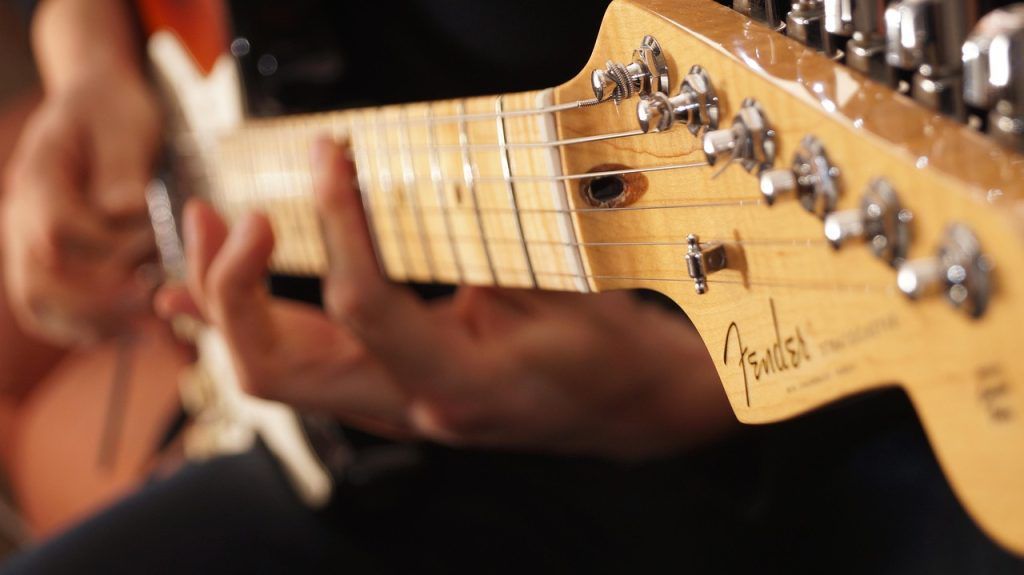
Mastering Hybrid Picking
2. Developing Right-Hand Coordination
The primary initial goal is matching the timing, tone, and volume between the pick stroke and the finger pluck.
Exercise 0: Fingers Alone (No Pick)
Before reintroducing the pick, spend a few minutes plucking simple patterns with m and a only — no p at all. This isolates finger strength and independence without the pick’s more dominant attack masking weaknesses in the fingers.
e|----0(a)----0(a)----|
B|-0(m)----0(m)--------|
Alternate m and a evenly, matching their volume and tone the same way you will against the pick in Exercise 1. Once m and a feel controlled and even on their own, bringing the pick back in is much easier to balance.
Exercise 1: Single Finger Isolation (p→m)
Set a metronome to 60–80 BPM. Focus on making both note attacks sound perfectly matched in volume.
e|----------------|
B|------0(m)------|
G|----------------|
D|----------------|
A|----------------|
E|-0(p)-----------|
Practise this fundamental exercise across various string combinations:
- Low E→B
- A→G
- D→B
- G→High E
Exercise 2: Multi-Finger Sequence (p→m→a)
Once single-finger execution feels natural, introduce the ring finger (a) to form a fluid rolling sequence.
e|-----------12(a)--------|
B|------12(m)-------------|
G|------------------------|
D|------------------------|
A|------------------------|
E|-0(p)-------------------|
3. Core Technical Applications
Essential Hybrid Arpeggio (Minor Triad)
Work through this arpeggio with two distinct articulations: first, let all notes ring together; second, execute each note as a crisp, detached staccato.
e|------12(a)------|
B|----13(m)--------|
G|-14(p)-----------|
Apply this same p→m→a engine across major, diminished, augmented, and dominant seventh shapes across the fretboard.
Classic Country Lick
This classic phrase combines traditional picked notes on lower strings with snapped finger attacks on higher strings. The four notes fall in a steady p→m→p→a order — pick, finger, pick, finger — played as even straight 8th notes:
e|------5(m)------8(a)----|
B|-3(p)------5(p)---------|
Pro tip: For a true “chicken pickin'” sound, snap the string slightly upward away from the fretboard before releasing it into the palm.
String Skipping & Legato Integration
Hybrid picking eliminates wide, awkward pick jumps. Instead of forcing the pick to cross open space, let the middle finger pluck the target note cleanly.
B|------7(m)-----------|
G|---------------------|
D|-5(p)----------------|
You can also pair this with legato techniques:
Pick Stroke → Hammer-on → Pull-off → Finger Pluck (m)Simultaneous Double Stops
Pluck two or more adjacent strings simultaneously using m and a together for clean chord accents, blues fills, and steel-guitar style double stops.
e|--5(a)--
B|--5(m)--
G|--------
4. Genre Breakdown
| Genre | Primary Applications | Mechanical / Dynamic Focus |
|---|---|---|
| Country | Chicken pickin’, double stops, pedal-steel bends | Snappy, aggressive finger releases; highly percussive |
| Blues | Sliding double stops, vocal phrase accents | Dynamic control, balancing warm finger notes with pick attacks |
| Rock / Metal | Fast arpeggios, wide string skipping | Precision, minimal motion, smooth volume balance |
| Progressive / Fusion | Hybrid legato, sweep-picking exits, complex rhythms | Clean separation, fluid velocity across multi-string lines |
5. Daily 30-Minute Practice Routine
- 00:00–05:00 (Warm-up & Balance): Single-finger isolation exercises (p→m), plus a minute of fingers-alone plucking. Focus entirely on equal volume and tone between pick and finger.
- 05:00–15:00 (Technical Drills): Run minor, major, and dominant seventh arpeggios using p→m→a. Focus on string skipping and clean double stops.
- 15:00–25:00 (Repertoire & Etudes): Apply the technique to real licks, solos, or songs within your target genre.
- 25:00–30:00 (Improvisation): Jam over a backing track, intentionally forcing wide intervals, double stops, and hybrid accents into your solos.
6. Equipment & Tone Optimization
- Pick selection: There’s no single correct stiffness — it depends on genre and desired blend. Stiffer picks (1.0–1.5mm+) give a brighter, more defined pick attack that some players prefer for rock, metal, and fusion. Many country and chicken-pickin’ players deliberately use thinner, more flexible picks so the pick attack sits closer in volume and brightness to the finger plucks, rather than overpowering them. Try both and listen for which blends better with your finger tone.
- Compression: A subtle compressor pedal helps equalize small volume differences between the flatpick and your fingers while preserving overall performance dynamics.
- Guitar action: There’s no universal ideal here either — it trades off with your dominant style. Lower action makes fast finger plucks and light legato easier but can limit how hard you can dig in for snappy chicken-pickin’ attacks without fret buzz; players leaning heavily on aggressive finger snaps often prefer action a touch higher than a pure legato or fusion player would. Medium-low is a reasonable starting point, not a fixed target.
7. Frequently Asked Questions
Should I grow out my fingernails for hybrid picking? It depends on your desired tone:
- Flesh only: Produces a warm, thick tone, but requires a slightly stronger finger attack to match the bright attack of a plectrum.
- Nails (1–2mm): Provides a sharp, defined attack that naturally matches the tone of a pick.
If you keep short nails, using a compressor pedal can help balance any natural tonal differences.
How do I fix quiet or weak finger notes? Because a pick is rigid, it naturally transfers more energy than an untrained finger. During practice, intentionally exaggerate the volume of your finger plucks while softening your pick stroke. Also check your attack angle: pluck by pulling the string slightly up and inward toward your palm rather than sliding across it lightly.
How do I stop unwanted string noise? Rely on two-point muting:
- Right hand: Keep the heel of your palm lightly resting on the lower unplayed strings (E, A, D).
- Left hand: Use the undersides of your fretting fingers to damp adjacent higher strings, preventing sympathetic resonance during large leaps.
Should I try using my pinky finger (c)? Master the pick + middle + ring setup first. The pinky is shorter and weaker than the other fingers, making hand balance harder to maintain. The p–m–a combination handles the large majority of hybrid picking repertoire — the pinky is a genuine extension for advanced players, not a gap most players need to fill early on.