How to Tune a Guitar: Complete Beginner’s Guide
Everything You Need to Know About Electronic Tuners, Apps, Relative Tuning, Common Mistakes, and Keeping Your Guitar in Tune
By James Stratton August 2026
Here we go!
Tuning your guitar is the single most important foundational skill you will learn as a new player. It is the very first thing you do before every practice, every jam, and every performance. An out-of-tune guitar will make even the most carefully practiced chords sound dissonant, messy, and unprofessional—no matter how good your technique is.
For many beginners, tuning feels like a frustrating guessing game. You turn the pegs, pluck the strings, and still it sounds wrong. You might wonder if you’re doing it wrong, if your guitar is broken, or if you just don’t have “a good ear.” The truth is: tuning is a learnable skill, not a talent you are born with. With the right tools, clear steps, and a little practice, anyone can learn to tune accurately, quickly, and confidently.
This guide takes you from absolute zero to fully capable. We cover every practical method—from the easiest electronic tools to tuning completely by ear—explain exactly why guitars go out of tune, and give you the habits that keep them sounding their best.
By the end you will be able to:
- Identify exactly what note every string should be
- Use every common type of tuner correctly
- Tune your guitar accurately without any tools
- Diagnose and fix almost every common tuning problem
- Keep your guitar in tune for longer
1. First Things First: Standard Tuning Basics
Before you touch a tuning peg, you need to know exactly what you are aiming for. Standard tuning (used in the vast majority of guitar music) sets the strings to these notes from thickest to thinnest:
| String Number |
Position |
Note |
Frequency (Hz) |
| 6 |
Thickest / Low |
E |
82.41 |
| 5 |
|
A |
110.00 |
| 4 |
|
D |
146.83 |
| 3 |
|
G |
196.00 |
| 2 |
|
B |
246.94 |
| 1 |
Thinnest / High |
E |
329.63 |
Easy ways to remember the order E–A–D–G–B–E
- Eddie Ate Dynamite Good Bye Eddie
- Eat All Day Get Big Easy
- Elephants And Donkeys Grow Big Ears
Essential terms
- Sharp (♯) – The string sounds higher than the correct note → loosen the peg slightly.
- Flat (♭) – The string sounds lower than the correct note → tighten the peg slightly.
- Chromatic – A tuner mode that recognises every note in music. Always use this mode.
- Relative tuning – Matching strings to each other rather than to an external pitch.
- Intonation – How well the notes stay in tune as you move up the neck.
- Reference pitch – The accepted standard (almost always A = 440 Hz).
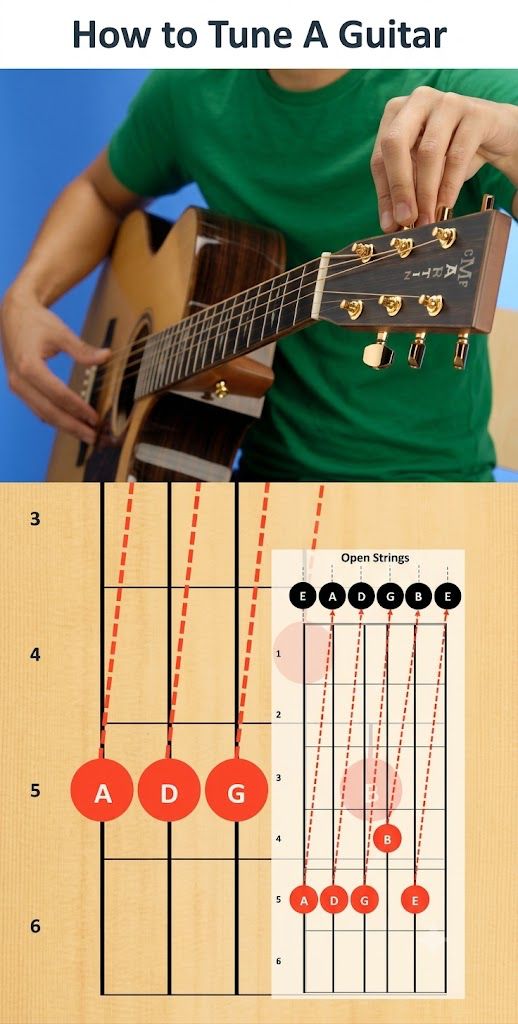
How to Tune a Guitar
2. Tuning with Electronic Tuners: The Best Method for Beginners
Electronic tuners remove the guesswork and are the fastest, most accurate option for new players.
2.1 Clip-On Tuners (The #1 Choice)
Clip-on tuners attach to the headstock and detect vibration through the wood. They work reliably even in noisy rooms or on stage.
Step-by-step
- Clip the tuner firmly near the centre of the headstock (not over the pegs).
- Switch it on and select Chromatic mode.
- Start with the Low E (6th string). Pluck it cleanly and let it ring.
- Watch the display:
- Needle/bar left or “♭” → tighten slowly.
- Needle/bar right or “♯” → loosen slowly.
- Centred + green light → in tune.
- Repeat for A, D, G, B, and High E.
- Go back and recheck every string once. Changing one string alters neck tension, so others often shift slightly.
Golden Rule Always tune up to pitch. If a string is sharp, loosen it well below the note first, then tighten it back up. This removes slack and improves stability.
2.2 Handheld / Microphone Tuners
Best in quiet practice spaces. Place the tuner 20–30 cm from the soundhole or pickups and follow the same process as a clip-on. Avoid noisy environments—they pick up background sound and give false readings.
2.3 Pedal Tuners
Ideal for electric players with amps and effects. Connect guitar → pedal input, pedal output → amp. Press the footswitch to mute the signal and tune silently. Perfect for live use.
3. Tuning with Apps: Free and Convenient
Your phone works well when you don’t have a physical tuner.
Recommended apps
| App |
Best Feature |
Cost |
| GuitarTuna |
Simple interface + chord tools |
Free / Premium |
| Boss Tuner |
Clean, professional display |
Free |
| Pano Tuner |
Sensitive visual wheel |
Free |
| DaTuner |
High precision for all instruments |
Free |
How to use apps correctly
- Find a quiet place.
- Hold the phone 15–30 cm from the soundhole or pickups.
- Turn off battery saver and close other apps.
- Pluck one string at a time, cleanly.
- Adjust until the app confirms the note.
- Double-check with an open chord.
Note: Apps rely on the microphone. Carry a small clip-on for noisy or live situations.
4. Tuning by Ear: Relative Tuning Methods
Learning to tune by ear trains your hearing and means you can always get your guitar into playable shape with no equipment.
You only need one accurate reference string to start (use a tuner, app, piano, or pitch pipe for the Low E).
4.1 The 5th-Fret Method (Foundation)
- Get the Low E (6th string) perfectly in tune.
- Fret the 6th string at the 5th fret → match the open 5th string (A).
- Fret the 5th string at the 5th fret → match the open 4th string (D).
- Fret the 4th string at the 5th fret → match the open 3rd string (G).
- Exception: Fret the 3rd string at the 4th fret → match the open 2nd string (B).
- Fret the 2nd string at the 5th fret → match the open 1st string (High E).
- Strum open E or A chords to confirm everything sounds balanced.
What to listen for When two notes are close but not matched you hear a pulsing or “beating” sound. As you get closer the beating slows. When it disappears and the notes blend into one steady tone, you are in tune.
4.2 Harmonic Tuning (Clearer, Longer Notes)
Touch the string lightly directly above the fret wire (do not press down), pluck, and lift your finger instantly.
Matching pattern:
- 6th string 5th-fret harmonic = 5th string 7th-fret harmonic
- 5th string 5th-fret harmonic = 4th string 7th-fret harmonic
- 4th string 5th-fret harmonic = 3rd string 7th-fret harmonic
- 3rd string 4th-fret harmonic = 2nd string 5th-fret harmonic
- 2nd string 5th-fret harmonic = 1st string 7th-fret harmonic
Use this after the 5th-fret method for extra precision.
4.3 Power Chord Check (Fast Validation)
Power chords reveal tuning errors quickly because they rely on pure intervals.
- E5: Low E + A string 2nd fret + D string 2nd fret
- A5: A + D string 2nd fret + G string 2nd fret
They should sound full and solid. Any wavering or clash means those strings need attention.
5. Why Your Guitar Keeps Going Out of Tune (And How to Fix It)
If you tune carefully but the guitar drifts quickly, the cause is almost always mechanical or environmental—not your ears.
New strings need stretching Fresh strings stretch a lot. After fitting them, tune roughly to pitch, gently pull each string away from the fretboard along its length, retune, and repeat 2–3 times. Play for 15–20 minutes and retune again. They stabilise after a day or two of this process.
Incorrect winding on the pegs Aim for neat, downward windings:
- Thin strings (B, High E): 3–4 turns
- Medium (G, D): 4–5 turns
- Thick (A, Low E): 5–6 turns
Loose or worn tuning pegs Gently tighten the small screws on the face of the tuners. If they still slip, consider replacing them—basic sets are inexpensive and make a big difference.
Nut or bridge slot problems Slots that are too tight cause strings to stick and jump sharp; slots that are too loose allow slipping. This is a quick, inexpensive job for a guitar shop or luthier.
Temperature and humidity Wood expands and contracts. Keep the guitar away from radiators, direct sun, open windows, and damp areas. Allow 5–10 minutes for it to acclimatise before tuning after a temperature change.
Old or dirty strings Change strings every 4–8 weeks (depending on playing time) and wipe them after sessions.
6. Pro Tips to Stay in Tune Longer
- Always tune up to pitch (loosen below the note, then tighten up).
- Recheck every string after the first full pass—neck tension shifts.
- Wash your hands before playing; oils and dirt reduce stability.
- Store the guitar in a case or on a sturdy stand.
- Get a professional setup once a year (action, intonation, nut, truss rod).
- Check tuning mid-session if you play for more than 30 minutes, especially before recording or playing with others.
7. How Long Does It Take to Get Good at Tuning?
Most beginners can tune reliably with an electronic tuner or app within the first session. Developing a comfortable ear for the 5th-fret method usually takes 1–3 weeks of regular practice (a few minutes each time you play). Within a month of consistent use, most players can get the guitar into good playing shape quickly and confidently. Progress is normal and expected—do not worry if the first few attempts feel slow or uncertain.
Simple practice drills for ear tuning
- Tune the Low E with a reference, then deliberately detune the other strings slightly and practise bringing them back using only the 5th-fret method.
- After tuning, play a few open chords and power chords, then close your eyes and try to identify which string (if any) has drifted by ear before checking with a tuner.
8. Alternate Tunings: A Quick Introduction
Once standard tuning feels solid you can explore others:
- Drop D – Lower the Low E one whole step to D (rock, metal, folk).
- Open G – D–G–D–G–B–D (blues, slide, classic rock).
- DADGAD – D–A–D–G–A–D (folk, Celtic, fingerstyle).
Always return to standard tuning when practising core skills—it remains your baseline.
Frequently Asked Questions
Do I need an expensive tuner? No. Reliable clip-on tuners cost £8–£25 and work extremely well for everyday use.
How often should I tune? Every time you pick the guitar up. At minimum, before every practice or performance.
My tuner says I’m in tune but it sounds wrong—why? This is almost always an intonation issue. Open strings are correct, but fretted notes are not because the string length is slightly off. A professional setup fixes this permanently. Until then you can compensate a little by ear for the frets you use most.
Can I learn to tune completely by ear? Yes. You still need a reference pitch for the starting string, but after that the relative methods work anywhere.
Is it normal for new guitars to go out of tune quickly? Yes—especially with new strings. Stretch them properly and give them a week or two. Persistent problems after that usually need a setup check.
Guitar Mode vs Chromatic Mode? Guitar Mode only shows the six open-string notes. Chromatic shows every note and tells you exactly how far sharp or flat you are. Always prefer Chromatic.
Can I break a string by tuning too tight? Yes. Turn pegs slowly and stop as soon as the tuner (or your ear) confirms the correct pitch.
Why does the B string feel harder? Its thickness and the interval jump make it slightly less forgiving. Smaller, slower adjustments help.
Remember
Tuning is not a chore—it is part of playing the guitar. Building the habit of checking and adjusting will improve your ear, raise your confidence, and make every minute of practice more enjoyable.
Start with a clip-on tuner or app to build confidence, then gradually practise the 5th-fret method. Be patient. Within a few weeks you will be able to tune quickly and reliably every time.
The difference between a beginner and a confident player is not speed—it is how well they listen. And it all starts with tuning.
🎸 Guitar Tuning: One-Page Quick-Reference Cheat Sheet
(Print this or keep it in your case)
Standard Tuning (Low → High) E – A – D – G – B – E Eddie Ate Dynamite Good Bye Eddie
Golden Rules
- Always tune up to pitch.
- Always use Chromatic mode.
- Recheck all strings after the first pass.
Quick Methods
- Clip-on / electronic → Chromatic → adjust until centred/green.
- App → quiet room → phone 15–30 cm from guitar → one string at a time.
- 5th-fret relative (after Low E is correct):
- 6th@5 = open 5
- 5th@5 = open 4
- 4th@5 = open 3
- 3rd@4 = open 2 (only exception)
- 2nd@5 = open 1
- Harmonics for fine-tuning (light touch above the fret wire).
- Validate with E5 / A5 power chords and open chords.
Common Fixes
- New strings → stretch + retune repeatedly.
- Pegs slipping → tighten face screws; rewind neatly.
- Temperature change → let the guitar settle, then retune.
- Old strings → replace every 4–8 weeks. (or when you believe necessary)
Pro Habit Wash hands, store properly, get a yearly setup.