Gibson Les Paul
The Gibson Les Paul: Complete History, Models, Tone & Legacy
From its 1952 debut to multi-million-dollar vintage icons, the full story of the guitar that defined rock, blues, and beyond.
Quick Answer
The Gibson Les Paul is a solid-body electric guitar first released in 1952, co-designed by guitarist/inventor Les Paul and Gibson president Ted McCarty. Featuring a mahogany body with carved maple top, it gained its legendary warm, sustaining tone after the addition of PAF humbucking pickups in 1957. Discontinued in 1960–61 and revived in 1968 after British blues players made original 1958–1960 “Bursts” famous, the model remains one of the most influential and played electric guitars in rock, blues, and metal. Original late-1950s Standards routinely sell for $300,000 to over $1 million.
Gibson Les Paul
Introduction
Few instruments carry the mystique, sonic authority, and cultural weight of the Gibson Les Paul. More than a guitar, it is a design icon, a tonal benchmark, and the foundation of countless classic recordings across jazz, blues, rock, and heavy metal.
Born in the early 1950s, nearly abandoned a decade later, and spectacularly revived by British blues guitarists, the Les Paul has endured as both a premium working instrument and one of the most valuable vintage guitars in existence. This guide covers its conception and evolution, materials and tone secrets, core models and signature editions, legendary players and defining tracks, plus its modern status.
Chapter 1: The Birth of an Idea (1940–1952)
In the late 1940s, hollow-body archtops dominated electric guitar, but feedback at high volume remained a problem. Lester William Polsfuss—better known as Les Paul—set out to solve it. A virtuoso guitarist, inventor, and recording pioneer, he built an early solid-body prototype around 1941: a pine block with neck and strings, flanked by non-functional hollow wings. He called it “The Log.” Gibson initially showed little interest.
The turning point came when Ted McCarty became Gibson president in 1950. Seeing the commercial success of Fender’s new solid-body models, McCarty approached Les Paul. In 1952 they reached a landmark agreement: Gibson would produce a solid-body guitar bearing Paul’s name, and he would receive royalties. Gibson’s design team (with key contributions often credited around the carved top) refined the concept into a production instrument.
The 1952 Goldtop – The First Les Paul
The original Les Paul Model (later nicknamed the Goldtop) featured:
- Solid Honduran mahogany body with carved maple top
- Gold lacquer finish
- One-piece mahogany set neck, 24¾-inch scale
- Brazilian rosewood fretboard with trapezoid inlays
- Two P-90 single-coil pickups
- Adjustable trapeze tailpiece and wrapover bridge
- Multi-ply cream binding
The mahogany-maple combination delivered a warm foundation with clear highs—thicker and rounder than contemporary Fender single-coils. Despite promotional efforts by Les Paul and Mary Ford (including hits such as “How High the Moon”), the expensive, heavy instrument remained a niche product through the mid-1950s.
Chapter 2: Evolution and the Golden Era (1953–1960)
Key Hardware Refinements (1953–1956)
The original trapeze tailpiece was replaced by the Tune-o-matic bridge (1954) and stop-bar tailpiece (1955). This combination dramatically improved intonation, sustain, and playability and remains the standard today.
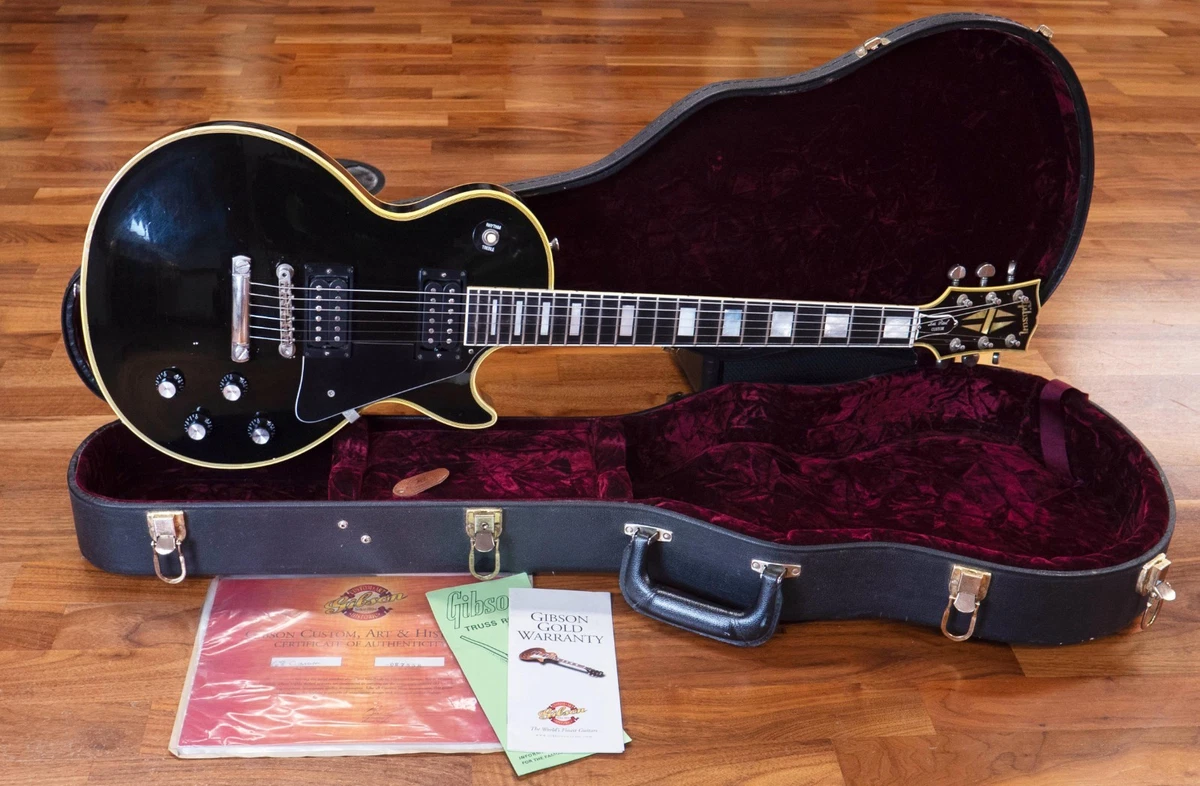
Les Paul Custom “Black Beauty” (1954)
Gibson’s flagship arrived in ebony finish with gold hardware, mother-of-pearl block inlays, and a split-diamond headstock inlay. Early Customs used an all-mahogany body and mixed P-90 and Alnico “Staple” pickups.
The Humbucker Revolution (1957)
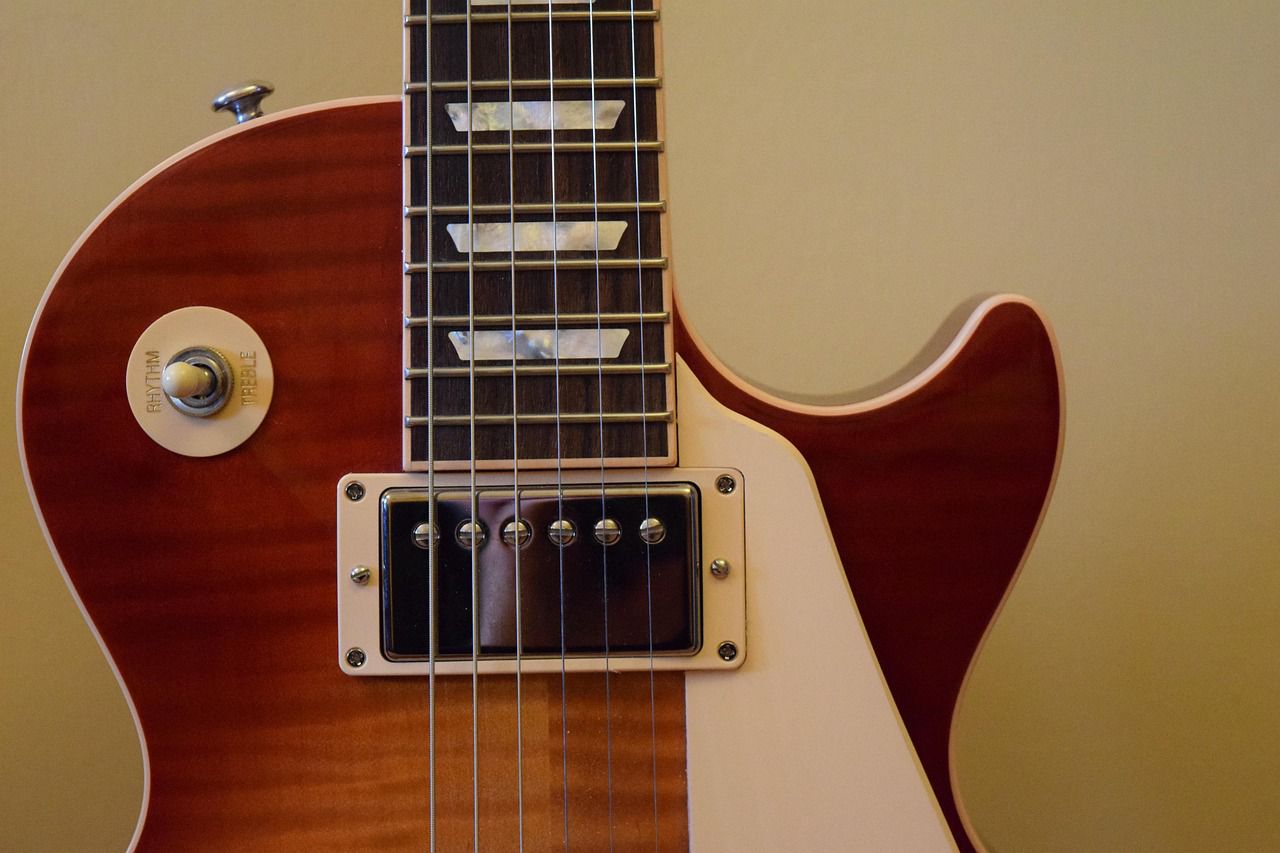
Engineer Seth Lover’s PAF (“Patent Applied For”) humbucking pickup transformed the instrument. Two coils wired out of phase cancelled 60-cycle hum while producing a thick, creamy, harmonically rich tone. By late 1957 both Goldtops and Customs carried PAFs—the voice that would define rock guitar for decades.
The “Bursts” (1958–1960)
In 1958 Gibson dropped the gold finish, revealing flamed maple under a translucent cherry sunburst, and renamed the model the Les Paul Standard. These “Bursts” (1958–1960) were produced in very small numbers (fewer than 1,700 total) and sold slowly at the time. Today they are the most coveted electric guitars in the world.
| Year | Neck Profile | Approx. Weight | Notable Traits |
|---|---|---|---|
| 1958 | Chunky, rounded “C” | 8.5–9.5 lbs | Thicker flame, deeper red burst |
| 1959 | Slightly slimmer, rounded | 8.5–9.0 lbs | Most sought-after balance of feel & tone |
| 1960 | Slimmer “shoulderless” taper | 8.0–8.5 lbs | Brighter response, faster-playing neck |
Junior and Special (1954–1960)
The single-P-90 Les Paul Junior and dual-P-90 Special (often in TV Yellow) offered simpler, more affordable options. Their raw, uncompressed tone later found favor in punk, garage, and blues.
By 1960 sales had declined against lighter double-cutaway designs. In 1961 Gibson replaced the single-cutaway body with a thin double-cutaway design that became the SG, effectively ending the original Les Paul line.
Chapter 3: Resurrection and Rock’s Golden Age (1961–1979)
While Gibson moved on, young British players discovered remaining late-1950s Bursts and found unmatched warmth and sustain.
- Eric Clapton’s 1960 Standard on Blues Breakers with Eric Clapton (1966) defined British blues-rock tone.
- Peter Green’s (later Gary Moore’s) 1959 Standard—with one pickup out of phase—produced the distinctive “nasal” chime heard on Fleetwood Mac’s “Albatross” and “Black Magic Woman.”
- Mike Bloomfield, Duane Allman, and others further elevated the instrument.
Demand forced Gibson to reintroduce the Les Paul Standard in 1968.
Classic Rock Icons
Jimmy Page (1959 Standard on landmark Led Zeppelin tracks), Neil Young (“Old Black” 1953 Goldtop), Paul Kossoff, Jeff Beck, Ritchie Blackmore, Mick Taylor, and Ronnie Wood cemented the Les Paul as the sound of 1970s rock.
1970s variations included the Deluxe (mini-humbuckers), updated Customs, Recording models, and gradual shifts to multi-piece necks and “pancake” body construction.
Chapter 4: Core Models and Signature Editions
| Model | Introduced | Key Specs | Character |
|---|---|---|---|
| Goldtop | 1952 | Mahogany/maple, P-90s → PAFs | Original warm classic |
| Custom | 1954 | Ebony board, gold hardware, block inlays | Premium, articulate |
| Standard | 1958–60, 1968– | Maple top, dual humbuckers, Tune-o-matic | Quintessential Les Paul |
| Junior | 1954 | Single P-90, slab body | Raw, direct |
| Special | 1955 | Dual P-90s, often TV Yellow | Bright, bluesy |
| Deluxe | 1969– | Mini-humbuckers | Tighter, clearer |
| Studio | 1983– | Stripped cosmetics, full tone | Modern workhorse |
| Historic / Traditional | 1990s– | Year-correct vintage specs | Collector authenticity |
| Modern / High Performance | 2000s– | Weight relief, updated electronics | Contemporary playability |
Notable signatures include Jimmy Page, Gary Moore/Peter Green, Slash, Ace Frehley, Randy Rhoads, and Adam Jones models, plus highly regarded ’59 Reissues (R9) and Black Beauty Customs.
Chapter 5: Materials, Design & the Secret of Tone
- Body: Honduran mahogany back (warmth, sustain, low-mid richness) + carved maple top (clarity, harmonic sparkle).
- Neck: Set mahogany, 24¾-inch scale—shorter than most Fenders for softer tension and warmer fundamentals.
- Fretboard: Brazilian rosewood (pre-1969), later Indian rosewood; ebony on many Customs.
- Pickups: Original PAFs (Alnico magnets, hand-wound, ~7.5–8.5kΩ) delivered unmatched balance. Modern Burstbuckers, Custombuckers, and T-Types aim to recreate that character with consistency.
- Hardware: Tune-o-matic + stopbar remains the gold standard for intonation and energy transfer.
- Finish: Nitrocellulose on historic models (ages and breathes); polyurethane on many modern production guitars.
Weight-relief chambers on many current models keep weight closer to 8 lbs while preserving tone.
Chapter 6: Legendary Players & Defining Recordings
1950s: Les Paul & Mary Ford – “How High the Moon”
1960s: Eric Clapton (“Steppin’ Out”), Peter Green (“Albatross,” “Black Magic Woman”), Mike Bloomfield, Duane Allman (“Statesboro Blues,” “Whipping Post”), Neil Young
1970s: Jimmy Page (“Whole Lotta Love,” “Stairway to Heaven,” “Kashmir”), Paul Kossoff, Gary Moore, Ritchie Blackmore, Mick Taylor
1980s–present: Slash, Randy Rhoads, Billie Joe Armstrong, Jerry Cantrell, Adam Jones, Joe Bonamassa, Alex Turner, and many more
Chapter 7: The Modern Era & Enduring Legacy
Gibson’s current lineup spans Original, Historic (Custom Shop), Modern, and Signature collections. Historic Reissues restored period-correct construction, while Studio and Modern models broadened accessibility and playability.
Original 1958–1960 Bursts have become blue-chip collectibles, with top examples exceeding $1 million. The design endures because it balances warmth and clarity, richness and bite, tradition and versatility—equally at home in jazz, blues, rock, and metal.
Why the Legacy Endures
The set neck, mahogany-maple construction, PAF-style humbuckers, and 24¾-inch scale were deliberate choices refined through decades of playing. As long as musicians seek sustain, harmonic complexity, and authoritative tone, the Gibson Les Paul will remain a benchmark.
FAQ: Gibson Les Paul
When was the first Gibson Les Paul made?
1952 (original Goldtop / Les Paul Model).
Why are 1959 Les Pauls so valuable?
Rare production (part of fewer than 1,700 Bursts total), highly figured maple, balanced neck profile, original PAF pickups, and association with players such as Jimmy Page and Peter Green.
Standard vs Custom?
Standard: maple-top workhorse with dual humbuckers. Custom: premium appointments (often ebony finish, gold hardware, block inlays); early examples were all-mahogany.
Why was production stopped in 1961?
Declining sales versus lighter double-cutaway designs led to the redesign that became the SG.
What pickups are in a Les Paul?
P-90s on early models; PAF humbuckers from late 1957. Modern versions use Burstbucker, Custombucker, or calibrated recreations.
Scale length?
24¾ inches (628 mm)—shorter than Fender’s typical 25.5 inches, contributing to the characteristic feel and warmer fundamental.

rock n roll fantasy
“The guitar is a small orchestra. It is polyphonic. Every string is a different color, a different voice.” – Andre Segovia