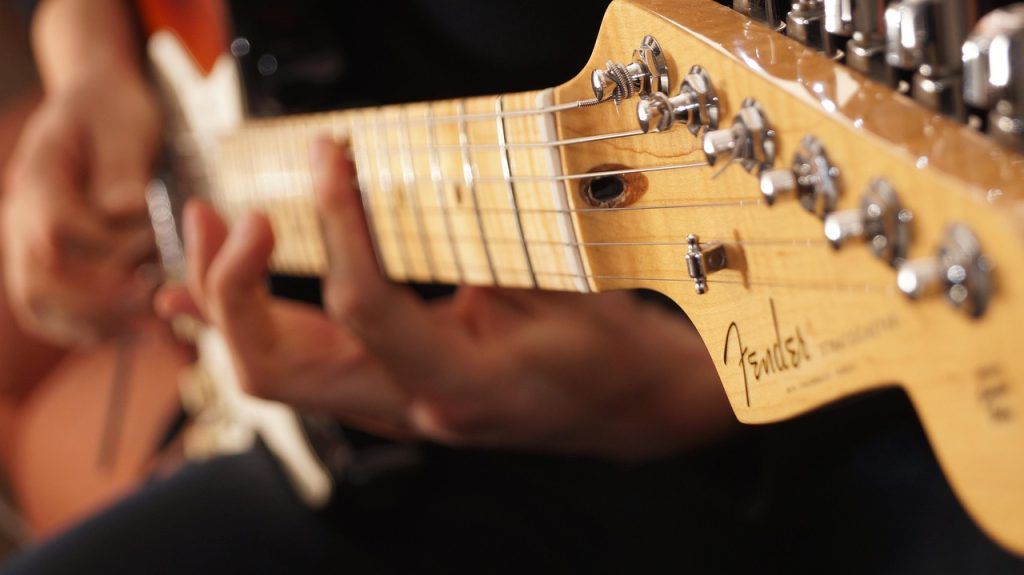
1964 Fender Stratocaster
The 1964 Fender Stratocaster: Inside the Final Golden Year of Pre-CBS Craftsmanship
Why collectors and players still rank the 1964 Fender Stratocaster among the most desirable electric guitars ever built
Some years become shorthand for excellence, and in the world of electric guitars, 1964 is one of them. The 1964 Fender Stratocaster sits at a singular crossroads: a decade of refinement behind it, and the sale of the Fender company to media giant CBS just weeks ahead. That timing alone has turned the 1964 Stratocaster into something close to legend — the last full year a Stratocaster left the Fullerton, California factory under the direct hand of founder Leo Fender.
A Decade in the Making
By 1964, the Stratocaster was already ten years old. Introduced in 1954, it had quickly become the electric guitar of choice for rock, blues, and country players, prized for its contoured “comfort” body, three single-coil pickups, and an innovative synchronized tremolo bridge that let players bend entire chords in pitch. A decade of small, deliberate refinements had sharpened the design without disturbing its essential character, and by 1964 the Stratocaster stood as the most mature expression of Leo Fender’s original vision — just before everything changed.
That change arrived in January 1965, when Fender sold the company to CBS. The sale ushered in an era of higher-volume, cost-driven manufacturing that many players and collectors believe gradually diluted the tone, feel, and build quality that had defined Fender’s first decade. Any Stratocaster built before that sale is now known as a “pre-CBS” Strat, and 1964 stands as the closing chapter of that revered era.
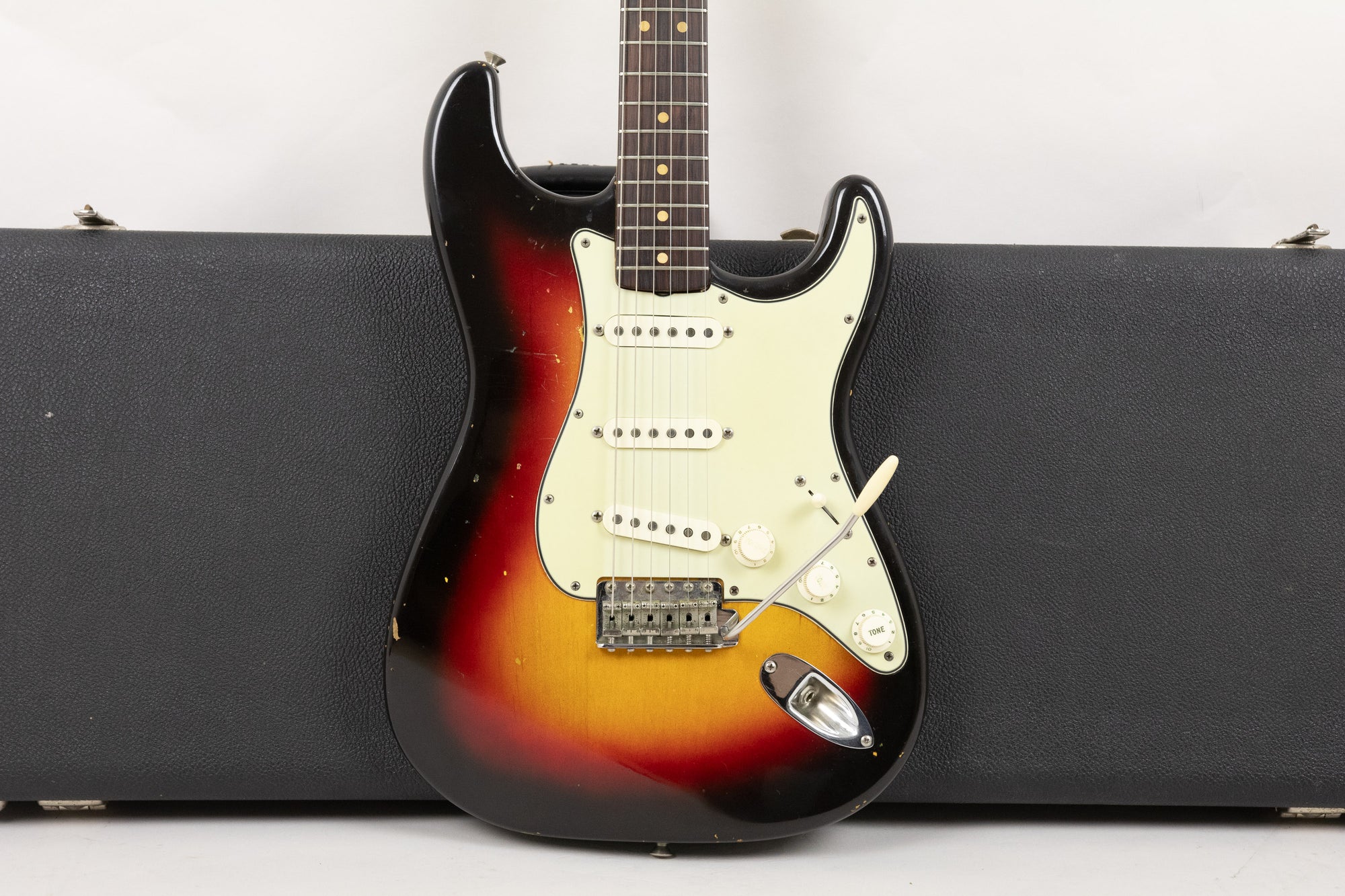
1964 Fender Stratocaster
What Makes a 1964 Stratocaster Distinctive
A handful of details set the 1964 Fender Stratocaster apart from both its predecessors and the guitars that followed it.
Body and neck. A typical 1964 Stratocaster paired a solid alder body with a bolt-on maple neck, topped with a thin veneer of Brazilian rosewood on the fingerboard — a tonewood now heavily restricted, which only adds to the guitar’s modern-day allure. Fingerboards from the first half of the year featured clay position-marker dots, later replaced by pearloid dots as the year progressed.
Headstock logo. One of the quickest ways to date a 1964 Strat at a glance is its headstock decal. Guitars built earlier in the year carry a thinner “Spaghetti” logo; by fall 1964, Fender had shifted to a bolder “Transition” logo in thicker gold script, listing four patent numbers.
Hardware and electronics. A 1964 Stratocaster typically shipped with three single-coil pickups, a synchronized tremolo bridge fitted with vintage-style saddles stamped “FENDER/PAT.PEND.,” and Kluson Deluxe tuning machines in either single-line or double-line script. A mint-green celluloid pickguard was standard, and Fender continued winding its own pickups in-house alongside Stackpole potentiometers — components tone purists still credit for the bright, “quacky” character of mid-1960s Stratocasters.
Finish. The standard finish was a three-tone sunburst, fading from a dark outer rim through a red band into a yellow center. Custom color finishes, increasingly common since 1958, were available for a modest upcharge.
Tone, Feel, and Why Players Still Chase It
Ask vintage-guitar players why the 1964 Stratocaster matters, and most circle back to tone. Many argue that while earlier-1950s Stratocasters carry higher price tags as collector’s pieces, mid-1960s models like the 1964 come closer to the sound players actually want — pickups with a bit more brightness and air, paired with rosewood fingerboards that hold up well after decades of refretting. One hands-on review from Guitar.com’s Vintage Bench Test series described a well-worn 1964 sunburst example with an unusually substantial neck profile, thicker than most other rosewood-board Stratocasters the reviewer had encountered, giving the guitar a distinctly muscular feel in the hand.
That balance of playability and tone is precisely why 1964 Stratocasters remain working instruments as much as museum pieces. Unlike the scarcest 1954 or 1957 examples, often considered too valuable to gig with, 1964 models were produced in greater numbers, and many surviving examples still see regular use on stage and in the studio.
Dating and Authenticating a 1964 Strat
Because Fender’s serial number system overlapped between years during this period, collectors and appraisers rarely rely on serial numbers alone to confirm a guitar’s age. A 1964 Stratocaster typically carries a five-digit serial number stamped on the back tremolo cover plate, generally falling somewhere between 75,000 and 95,000 — but the most reliable identifier is the pencil-written date hidden on the neck heel, visible only once the neck is removed from the body. A separate ink-stamped code on the heel adds further detail, recording the model, the month and year of production, and a letter denoting neck width; the Stratocaster’s model code in 1964 was “2,” with “B” marking the standard neck width. Serious buyers often cross-reference these neck dates against potentiometer codes and pickup construction, since Fender’s pickups shifted from black bobbins with yellow ink-stamped dates early in 1964 to grey bobbins with pencil-written dates by mid-to-late year.
What a 1964 Stratocaster Costs Today
Even when new, the Stratocaster was a premium instrument. Fender’s official 1964 price list showed four separate listings for the model, ranging from $259.50 to $349.50 depending on finish and options. Six decades later, that modest factory price has become a serious collector’s investment. Vintage dealers report that well-preserved, all-original 1964 Stratocasters — particularly those retaining their original pickups, electronics, and finish — now routinely command five-figure sums, with prices continuing to climb as the pool of surviving instruments shrinks and demand from both players and investors grows.
A Guitar Caught Between Two Eras
What makes the 1964 Fender Stratocaster so compelling isn’t only its specifications, but its position in history. It was built at the exact moment a founder-led workshop gave way to corporate manufacturing — the last instrument to carry the undiluted DNA of Leo Fender’s original design before mass production took hold. For collectors, that makes every 1964 Stratocaster a tangible link to the final year of Fender’s original vision: produced in greater supply than the scarcest 1950s runs, yet with authenticity fully intact.
Whether prized for its tone, its playability, or simply its place at the close of an era, the 1964 Fender Stratocaster endures as one of the most sought-after production electric guitars ever made — proof that sometimes the final chapter of a story is also its finest.