Guitar Code
The Guitar Code: Why These Chord Progressions Sound So Good It’s Almost Cheating
Ever Wonder Why Some Chords Sound Like Instant Hits? This Is the Secret.
If you’ve ever strummed a few chords on a guitar and suddenly felt like you were writing a chart-topping song—you’re not imagining things. Some chord progressions just work. They trigger emotions, feel intuitive under your fingers, and sound instantly familiar.
But here’s the kicker: it’s not magic, it’s music theory + clever guitar layout. In this article, we’ll reveal the most powerful chord progressions to learn on guitar, why they sound so good, and how you can use them to supercharge your playing and songwriting—even if you’re a beginner.
Let’s dive into the secrets behind the sounds.
Understanding the DNA of Music: What Are Chord Progressions, Really?
At their core, chord progressions are the emotional engine of music. They’re simply sequences of chords that follow a logical pattern, creating a sense of direction, emotion, and resolution.
On the guitar, they become even more powerful because of:
-
The unique resonance of open strings
-
The convenient shapes and fingerings
-
The ability to strum, pick, or arpeggiate with feel and flow
The best part? You don’t need to be a music theory wizard to use them effectively.
Progression #1: The “Pop Song Generator” (I–V–vi–IV)
✅ Why it works:
This progression is the king of mainstream music. It moves from a strong major chord, builds tension with the V, dives into emotional territory with the vi (minor), and resolves satisfyingly with the IV. It’s everywhere—from Ed Sheeran to Green Day.
Example in C major:
C – G – Am – F
Guitar Shapes:
-
C: x32010
-
G: 320003
-
Am: x02210
-
F: 133211 (or easier: xx3211)
Songs that use it:
-
“Let It Be” – The Beatles
-
“With or Without You” – U2
-
“Someone Like You” – Adele
SEO Note: This is one of the most searched progressions by beginner guitarists.
Progression #2: The “Heartbreaker Loop” (vi–IV–I–V)
✅ Why it works:
It starts in minor (emotional), then climbs into uplifting territory. Think of it like going from heartbreak to hope. Often found in acoustic ballads and emotional pop.
Example in A major:
F#m – D – A – E
Guitar Shapes:
-
F#m: 244222
-
D: xx0232
-
A: x02220
-
E: 022100
Songs that use it:
-
“Apologize” – OneRepublic
-
“She Will Be Loved” – Maroon 5
-
“The Scientist” – Coldplay (variation)
Guitar Code
Progression #3: The Jazz Flow (ii–V–I)
✅ Why it works:
This one is the lifeblood of jazz. The tension from the ii to the V makes the final resolution to I ultra satisfying. It’s sophisticated, smooth, and addictive.
Example in C major:
Dm7 – G7 – Cmaj7
Guitar Shapes:
-
Dm7: xx0211
-
G7: 320001
-
Cmaj7: x32000
Guitar Tip:
Great for practicing fingerpicking, jazz voicings, and smooth transitions.
Progression #4: The “Doo-Wop Classic” (I–vi–IV–V)
✅ Why it works:
This is old-school gold. A staple of 1950s hits and modern pop, this loop carries deep emotional range—from romance to nostalgia.
Example in G major:
G – Em – C – D
Guitar Shapes:
-
G: 320003
-
Em: 022000
-
C: x32010
-
D: xx0232
Songs that use it:
-
“Stand By Me” – Ben E. King
-
“Earth Angel” – The Penguins
-
“Every Breath You Take” – The Police (modulated)
Why Guitar Makes These Progressions Sound Even Better
1. Open Chords Ring Beautifully
Keys like C, G, and D allow you to use open strings, which resonate and fill the room. They create lush, full textures that are naturally pleasing.
2. Voice Leading Makes Transitions Smooth
Your fingers often move only slightly between chords (e.g., C to Am), which keeps the notes close together and the harmonies connected.
3. The Guitar Is Built for Rhythm
Strumming adds momentum. You can turn even simple progressions into rhythmically interesting parts with just your right hand.
The Secret Sauce: Diatonic Harmony Explained Simply
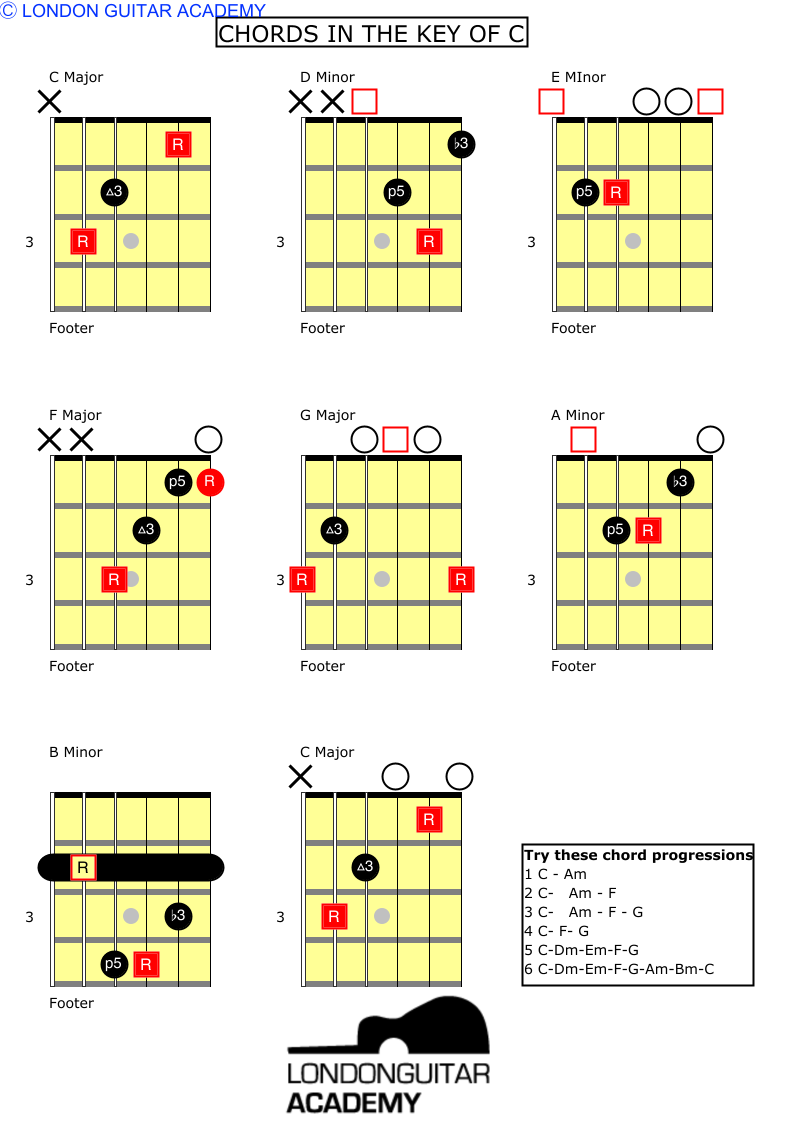
In any key, chords are built from the scale. Here’s how C major works:
| Scale Degree | Chord | Type |
|---|---|---|
| I | C | Major |
| ii | Dm | Minor |
| iii | Em | Minor |
| IV | F | Major |
| V | G | Major |
| vi | Am | Minor |
| vii° | Bdim | Diminished |
Sticking to these chords creates progressions that sound “right” because the notes all come from the same pool.
That’s why songs using I–IV–V or vi–IV–I–V progressions are instantly pleasing.
Tension and Release: The Emotional Engine of Great Chords
-
The V chord (dominant) feels like it wants to resolve to the I (tonic).
-
The vi chord (minor) adds sadness or longing.
-
The IV chord softens or delays the return to I.
-
Adding diminished chords or secondary dominants spices up your songwriting.
Example:
C – E – Am – F (E is not in C major—it’s a borrowed chord that pushes powerfully into Am.)
Why Some Chords “Break the Rules” and Still Sound Amazing
Modal Interchange
Borrow chords from the parallel minor/major key to add emotion.
Example: Use an Eb major in C major for a dramatic, unexpected twist.
⚡ Secondary Dominants
Insert dominant chords to prepare other chords.
Example: Play E major (V/vi) before Am in the key of C.
These tricks give your progressions an edge—and make them sound pro.
How to Learn These Progressions Like a Guitar Ninja
-
Transpose Progressions – Use a capo to try them in all keys.
-
Loop and Record – Build your own backing tracks to jam over.
-
Write a Melody – Hum or sing over the chords to train your ear.
-
Analyse Songs You Love – Most hits follow just 1 or 2 of these progressions!
Bonus Music Theory: Voice Leading and Inversions
Voice leading = moving from one chord to another with minimal motion.
Example:
-
C (x32010)
-
Am (x02210)
These chords share two notes: C and E. That’s why they feel connected.
Chord inversions (where you change the bass note) also smooth transitions:
-
C → Am/G → F = beautiful descending bassline!
Quickfire Progressions Worth Trying Right Now
| Progression | Key Example | Feel |
|---|---|---|
| I–IV–V | C–F–G | Uplifting, folk-pop |
| i–VII–VI–VII | Am–G–F–G | Dark, dramatic |
| I–V–ii–IV | C–G–Dm–F | Soulful, smooth |
Final Chord: Why These Progressions Make You Sound Like a Pro
Great chord progressions are your secret weapon. They’re simple to learn, emotionally powerful, and widely used in everything from Taylor Swift to The Beatles to Billie Eilish.
But more than that, they’re a gateway to songwriting, improvisation, and personal expression. Whether you’re writing songs, playing covers, or just jamming, understanding why chords sound good together puts the magic in your hands.
So plug in, tune up, and start exploring the most powerful chord progressions in music.
They don’t just sound good—they make you unforgettable.